
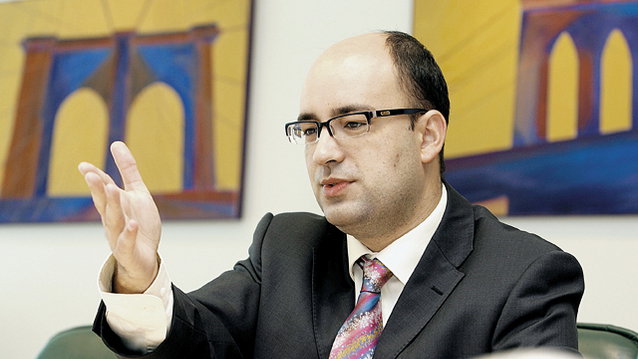
He started the company four years ago, alongside Cristina Filip and other partners.
Although he is less involved in cases and PeliFilip started out in 2008, shortly before the beginning of the crisis, PeliFilip has made room for itself on the legal market and continues to be active even on the real estate segment. Demand is weak for real estate projects as banks, whose balance sheets include a lot of non-performing assets, are not very willing to provide financing.
“Banks are clearly looking to separate viable projects from problem ones. But I believe it is not in their interest to sell “their skeletons” now and at any price because at the current prices, they could not grant much financing with the funds they got from selling them. So they will probably be able to afford to get rid of the ‘skeletons’ when they start earning money from new projects, Peli told ZF in an interview.
A bulky case
Despite the difficult situation on the real estate market, Peli Filip currently has a team of 14 lawyers who offer real estate consultancy, although acquisitions and new developments are few currently.
But older developments led to a large number of court cases, with PeliFilip having a litigation team that assisted clients such as AIG/Lincoln and BelRom in disputes with construction firms.
An arbitration case was closed this year, in which Portuguese-held Engil asked for EUR11 million from the developers of the Lakeview office building in Bucharest (AIG/Lincoln and DPGS) after the construction contract was terminated, but the claim was rejected and the court ultimately ruled in favor of the developers, so the construction company ended up paying EUR0.5 million to AIG/Lincoln and DPGS.
“It was the bulkiest case at the Bucharest Court of Arbitration, on which I worked for two years and a half,” says the representative of PeliFilip, which assisted the building owners in this case.
From zero to 14 people
On the litigation segment the portfolio of PeliFilip also includes companies such as RCS&RDS, Ford, Coca-Cola, Royal Bank of Scotland and drug producer Bayer, which this year was fined by the Competition Council in a case that involved several pharmaceutical companies. The department is headed by Catalin Alexandru, a lawyer who last autumn was promoted to partner.
“We currently have 14 people in the litigations department, from none three years ago. We tell the client from the very start what their chances are if the case goes to court and we try to support them along the way, as opposed to the old mentality of litigation lawyers: ‘I took the case and will let the client know if the they won or not,'” Peli says.
The lawyer doesn’t offer information on the firm’s revenues, only says it rose from year to year, with the team also growing to 57 lawyers.
“We recruited 12 people for entry-level jobs, this is the best way to hire for us. (…) Since the firm was set up, we have not done a lot of lateral hiring [recruiting experienced lawyers from competition], we preferred organic growth.”
Politics and question marks
Peli says this was a year that didn’t stand out very much in terms of business from 2011, quite the contrary, the turmoil on the political scene raised several question marks for investors, and even had an impact on the activity of the law firm.
“We lived cut off from politics for many years – what happened in the office had nothing to do with what we saw on TV at night – but developments in the summer have however left their mark on the business world. When you end up explaining issues of constitutionality to clients, especially institutional ones – under what circumstances a president can be suspended – you have a problem.”
As transactions were few, on the financing side the company was involved more in restructuring cases. It assisted banks such as RBS, MKB and ING, while on the capital market PeliFilip in consortium with Linklaters, assisted GDF Suez Energy Romania in a 250 million-lei bond issuing on the Bucharest stock exchange.
(English version by Daniela Stoican)