
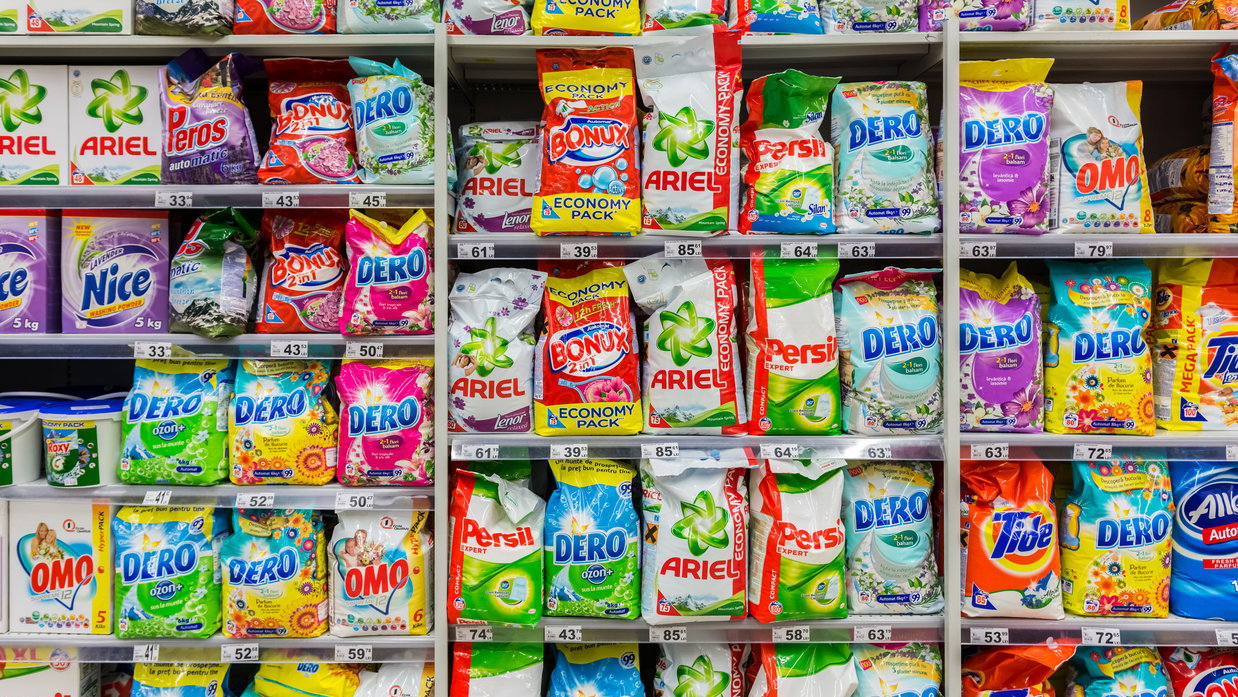
A Romanian spends EUR11.9 on detergent a year, more than a Pole (EUR11.5) or a Hungarian (EUR10.9) but less than a Czech (EUR14) or a German (EUR16.9).
Second tier producers, importers and distributors say they cannot enter certain segments such as powder detergent because the Romanian market is saturated and the international giants are fighting a price battle that would not allow them to make any profit.
Competitors on this market started a real price war during the crisis, fighting in promotions and special offers to attract Romanian consumers that became more careful about how they are spending their money.
Whereas international giants can afford to fight this war on long term because of their financial strength, small companies cannot cope.
“We tried to import a powder detergent brand and sell it in stores in Romania but after analyzing the market we realized we could not possibly cope because in their battle over customers, the major players cut prices by special offers and promotions. To get into this game we had to lose money,” says the representative of a local household care product company.
The top three companies in Romania account for 76.5% of the market together, and Procter&Gamble’s market share alone stands at 38.4%. Number two on the market is Unilever, almost 25%, followed by Henkel, 13.5%, according to the data supplied by market research company Euromonitor.
The same goes for the other markets in the region and as well as for Germany. Moreover, the market shares of the top three companies stand at almost 90% in Hungary and at more than 80% in Czech Republic.
Whereas Procter&Gamble and Henkel are top three companies an all five markets – Hungary, Poland, Czech Republic, Romania and Germany, Unilever, with its Omo and Dero brands, is a top three player only in Romania.
Dero is a local brand, made by Unilever in Ploiesti and is also one of the most powerful brands of the group in Romania, as it said in 2013. Unilever arrived in this country in 1996 when it bought the Dero detergent plant in Ploiesti from the government, where it is now making Dero products and other brands. Unilever also opened a second production facility close to the detergent plant in Ploiesti.
Dero is the only Romanian brand on the market and targets low to average-income consumers. It is the top selling detergent by value, ahead of Ariel (20.6%), Bonux (10%), Persil (8.6%) and Tide (7.7%). Dero’s market share is 22.3%, so one in four lei spent on detergent is spent on this brand.
A Romanian spends EUR11.9 on detergent a year, more than a Pole (EUR11.5) or a Hungarian (EUR10.9) but less than a Czech (EUR14) or a German (EUR16.9). Detergent spending is 2.5% higher in Romania this year, according to Euromonitor.
As the promotions war continues, the increase can be only be because of a rise in consumer spending, which is much lower than in the Western countries and in the countries in the region.
Hans Dewaele, who runs the local operations of Procter&Gamble, says consumption of personal and household care products in Romania is much lower than in the Western countries.
However, Romania only began using certain product categories twenty years ago so it will take a while before it catches up with the West, he added.
Although detergent consumption is lower in Romania than in Poland and Hungary, for instance, the annual spending is higher. Data supplied by market research company GfK showed the difference came from the average prices per kilo, higher in Romania than in the other two countries, even though the latter’s economies are more developed and wages are higher.
Jarek Malinowski, the executive who runs the EUR180 million retail business of Unilever South Central Europe has recently said that the 24% VAT and the markup of retail chains are to blame for the shelf prices of the products in Romania. Prices of a number of products are the same as in the West, even though wages are five to six times lower.
Volumes sold in Romania are lower, but their price is higher, on a market of hypermarkets and supermarkets. In Germany, for instance, the market is dominated by discount stores, he added.
However, shelf prices have been going down in the past few years as a result of the competition among fast moving consumer goods industry companies.
Consumption of detergent per capita is looking good, Malinowski said, adding that Romanians are buying larger detergent packs (economy packs i.e.) so in the end they pay less per kilo than the people in the other countries in the region.
(English version by Loredana Fratila-Cristescu)