
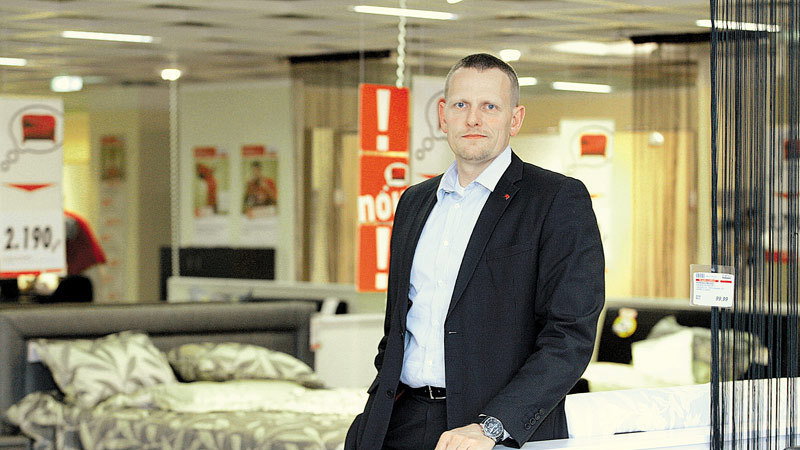
Austrian kika/Leiner group (including the store in Militari, western part of Bucharest) was taken over by South-Africa’s Steinhoff Group this year, in a deal completed in November, once competition authorities approved it. Steinhoff started as a German furniture business that Bruno Steinhoff established in 1965, which then entered South Africa in 1997 and was listed on the Johannesburg Stock Exchange a year later.
“This year was a year of transition towards what we needed. We started cutting prices in March, which made a positive impact,” Lund told Ziarul Financiar in an interview.
Lund took over management of the business in Serbia (where kika only has one store) and Croatia (where it has four stores) in March, but continues to live in Romania, in Bucharest’s Old Town, which he sees as a lively area.
He started his term in Romania in 2009, about one year after the opening of the store in this country, which required EUR31 million investments.
“The year started very well, we had a slowdown in the summer and are now recovering. I could say 2013 has been a roller-coaster year.”
This was due to both internal and external factors, he said. The company is currently measuring its financial year starting April, but things will change in 2014, because of the takeover by Steinhoff. The papers were completed at the end of November.
The deal had been signed in the summer and then the companies sought the approval of the competition authorities in Brussels and had to wait a while because Croatia joined the EU, Lars Lund said.
Since the deal was completed a little while ago, Lund says the new shareholders have not finalized their plans for Romania, but he for one would like to see them open more kika stores in the country.
kika announced plans to expand ever since it arrived in Romania, but has not done anything in this regard yet.
“Steinhoff is one of the largest retailers in Europe, and as far as we are concerned this means know-how and access to manufacturing and logistics.”
kika is positioned as a medium-priced retailer but Lars Lund found, to his surprise, that more expensive products such as Oriental rugs with a price tag of EUR10,000 or lighting fixtures decorated with Swarovski crystals, too, sell. Sofas are the store’s best sellers, followed by bedroom sets.
Products that do less well, on the other hand, are the hallway furniture items, because people either have no such hallways in their homes or no room for such furniture, kika’s boss said, adding overall sales are very good this December.
“We only have one store in Romania. The focus has been on expansion in other areas.”
Lars Lund says he does not know what the plans for Romania are, but he would like to see more stores opened in this country. However, it remains to be seen what the company’s focus will be.
Both kika and Steinhoff buy furniture from Romanian manufacturers. kika’s biggest supplier of sofas is Cotta International.
Romania has not lost is furniture making craft, a combination of quality and manufacturing costs. Croatia, for instance, has low but expensive production. As infrastructure improves in Romania, the access of manufacturers from a smaller city to the market improves, as well, kika’s country manager said.
kika Mobilier SRL posted 45.5 million lei (EUR10.2 million) revenue in 2012 and RON13.4 million profit, according to Finance Ministry data. Lund said the entire company would not make any profit this year because of the head office and because of operating only one store, which is why he would like to see expansion.
kika operates on a furniture market estimated at EUR700 million, where rivals include Mobexpert, IKEA, Elvila and Lem’s. (EUR1=RON4.4537)
(English version by Loredana Fratila-Cristescu)