
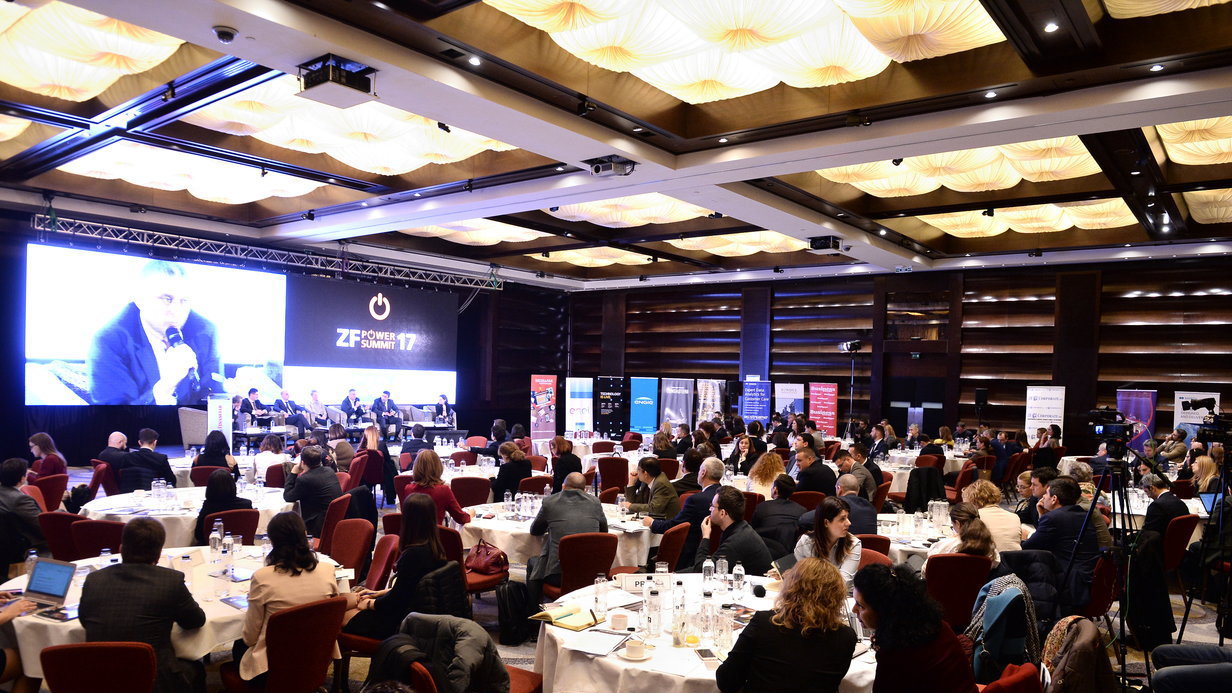
The event, held on February 20-21, opens the ZF conference season and has become a reference on the market in only six years thanks to the quality of its guest speakers and debates generated.
This year’s edition received support from Engie, MOL, Nuclearelectrica, CEZ Group, Electrica, KMG International, Hidroelectrica, OMV Petrom, PeliFilip, Fondul Proprietatea, SAP, Marsh, Intrarom, Transelectrica, Enel, Adrem Invest, ECI The Elastic Network and Aqua Carpatica.
“Look at the trends shaping today’s society, urbanization, electric mobility and digitalization, the Uber-ization of all things and mix these trends with the constant technological progress, which in our sector mostly translates into the digitalization of networks, much more efficient energy storage systems, the active role of consumers,” said Andrea Valcalda, head of sustainability with the Enel group, one of the special guests at this year’s ZF Power Summit.
The result will be a new way of generating and delivering power, which shapes our old energy model. The fast-paced progression of things renders investment projects that start generating revenue after a longer while unattractive. Today’s estimates have no way of turning out to be true in ten years from now, so everything that cannot generate value within two years becomes unfeasible, Andrea Valcalda added.
While the utility groups are putting huge projects behind them, Romania continues to include in its strategy investments it cannot pay for in the absence of firm commitments from partners.
“Romania needs new generators, and reactors 3 and 4 of Cernavoda plant are an option for Romania. It may seem alarming when hearing that to ensure the same stability for the energy system you must invest EUR20 billion. The government will clearly not be able to invest the entire amount,” admits Corina Popescu, state secretary with the Energy Ministry.
Volatility in the sector is another factor affecting appetite for very long-term investments, and the start of this year is clear proof that market mechanisms still need fine-tuning.
“The marketing getting cleaned up (after the insolvencies announced by some suppliers i.e.) is a good thing. It has happened in other countries, too, not just in Romania. I think that everything that happened in these two months should serve as a warning call for suppliers in Romania, they took the risks. I think they should change their strategy and sign medium and long-term contracts for electricity. I don’t think it was a case of market manipulation,” Corina Popescu said.
While the electricity market has made significant progress, in that it has both trading platforms in place and competition among producers, the natural gas business has yet to go beyond the construction phase.
“I think the issue of consumer vulnerability must be properly addressed,” said Eric Stab, chairman and chief executive officer of ENGIE Romania.
It is an issue that has been discussed a long time. One must say not only who is vulnerable, but mainly who is not. This is the main difficulty, Eric Stab says, adding he hopes to see a solution to the problem as soon as possible.
Other market actors criticized the market for how closed it is. Gas producers say they are also affected by the Russian imports, which have become cheaper than local production, and they have no export solutions since demand has been dwindling.
“The Romanian market is a closed market where exports are insignificant compared with imports. One cannot export but can import. It would be good to have a strategy before going ahead with deregulation,” said Virgil Metea, general manager of Romgaz, the largest local natural gas producer.
Despite all the obstacles, the utilities market, especially the regulated segment, has attracted investors, and the best example in this regard is Allianz Capital Partners buying into E. ON Distributie Romania.
“I cannot talk about Allianz Capital Partners’ policies but the arrival of such an investor is a very good sign for the Romanian market,” said Frank Hajdinjak, general manager of E.ON Romania.
If such a partner comes to Romania, which brings huge funds for investments, it means it has confidence in the market and will attract other investment funds. It is a positive sign for the Romanian market. Therefore the market must be developed and give such investors the chance to make money, Hajdinjak added.
(English version by Loredana Fratila-Cristescu)