
Oltchim has been listed since 1997 and could have become a model to follow, as were CEZ (the Czech Republic), KGHM and PNK Orlen (Poland), and Mol and Richter (Hungary), but is now one step away from liquidation.
The stock exchange, Fondul Proprietatea (FP.RO) and brokers have for years sought to persuade the state that privatizations through the capital market are the best solution for making state-run companies more efficient and more transparent.
But paradoxically some of the state-run companies listed on the stock exchange are in even poorer shape than unlisted companies, one negative example being Oltchim Ramnicu Valcea (TEL.RO), which has ended up in a disastrous situation, with the state now seeking to sell it at any price to salvage what it can.
Transelectrica Bucuresti (TEL.RO), listed in 2006, is another example of a company that has not managed to become more efficient or more valuable after getting listed, while Oil Terminal (OIL.RO) has been plundered in the past few years, without the fact that it is listed in the first tier of the stock exchange acting as a deterrent.
This compares with the performance of Poland, the Czech Republic and Hungary, which turned their state-run companies into regional champions, making use of the advantages of stock exchange listing. These countries sold major stakes in state-run companies, hanging on to just 25-50%. In this way they managed to attract the money necessary for the development of these companies and finalize expansion in the region.
On the other hand, the Romanian state, which holds much bigger stakes in its listed companies, hasn’t managed to do anything. And this is in part to do with the fact that the government has always disregarded the capital market and turned a blind eye to abuses, never applied corporate governance principles to the companies it controls and never sought to make them efficient, while the capital market for a long time lacked a sufficiently strong voice to hold the government to account.
This made it possible for Oltchim, which is listed in the first tier of the Bucharest Stock Exchange, to accumulate debts of over EUR700 million and losses of around EUR300 million in the past five years, although it is one of the largest producers in the chemical industry in Europe.
“There isn’t one single solution to make state-run companies more efficient. It’s not enough to list a company or to just change its management. At Oltchim the fact that the state controls 54% was one of the weak points. Another problem were the transformations that the Romanian industry has been through, with the company investing a lot in the petrochemical industry although it did not have a refinery. A further problem was that many names in business and in politics were involved in Oltchim,” said Remus Vulpescu, head of the Office for State Participations and Privatization in Industry, in answer to ZF’s question as to why Oltchim is one step away from bankruptcy, although it was listed on the stock exchange.
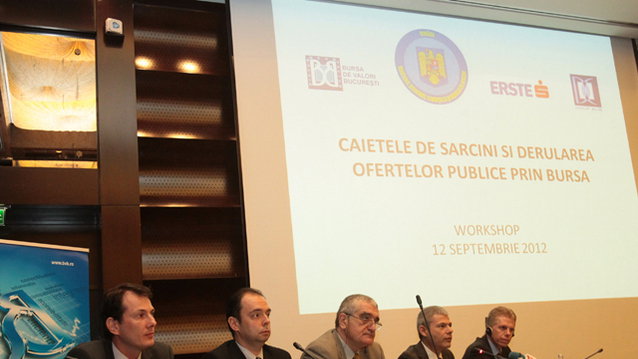
Vulpescu spoke at a seminar on the state’s public offerings organized Wednesday by the Bucharest Stock Exchange. The official went on to say:
“Oltchim will not make it for more than two or three months unless we manage to privatize it and restart the plant.”
Visibly irritated by ZF’s question, Victor Cionga, the new general manager of the Bucharest Stock Exchange, answered virulently:
“Do you know when Oltchim was listed? Oltchim’s listing is a historic one, things have changed a lot since then. The company has had historic debts, that’s why it ended up in this situation, said the executive, asking ZF what other companies privatized on the stock exchange in the past now have efficiency problems.
One example is Oil Terminal, a company that for many years had monopoly over transit of oil products through the port of Constanta. The company was listed on the stock exchange in 1998 and the state holds 59.6% of the shares, with the rest being controlled by stock exchange investors. The company ended last year with turnover of EUR27 million and a net profit of around EUR100,000, with a report put together last year by fiscal authorities ANAF bringing to light unjustified expenditures: thousands of euros spent on items such as handbags and expensive drinks, using the card of general manager Silviu Wagner, at the expense of the company.
The privatizations that the state wants to make in the future will be done by selling minority stakes, of 10% or 15% of the capital, in Romgaz, Hidroelectrica and Nuclearelectrica, so the state will continue to hold control of the companies, just as in the case of Oltchim and Oil Terminal. So it is extremely necessary for the Bucharest Stock Exchange, alongside the other institutions on the capital market, to have the force to impose standards of transparency, efficiency and corporate governance specific to any capital market in the world, in order for the stock exchange listing to genuinely help develop these companies rather than be just a target to check off a list, pressured by the IMF.
(English version by Daniela Stoican)