
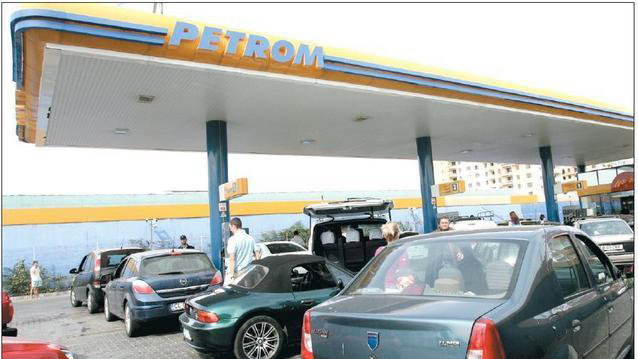
According to the results announced by the company, its net margin calculated as a ratio of net profit and sales stood at 16.6% last year. Calculating it for other oil companies to have announced their 2011 results, one can see Petrom is far ahead of its peers.
For instance, giant ExxonMobil, world’s largest oil corporation, posted $42 billion in net income, eight times Petrom’s revenue, but its profit margin was 8.6%, half the margin of Petrom. Neither Shell nor BP were more profitable than the Romanian company, as their margins stood at 6.6% and 6.9% according to their 2011 results.
Petrom can hardly find a match in the region, as well, considering Poland’s PKN Orlen operated at a 2.9% margin last year, while Croatia’s INA’s margin was 8.7%. Serbia’s NIS is the only company to have beat Petrom in terms of profitability, thanks to its 21.7%. Petrom’s was also over three times most profitable than its owner, Austria’s OMV. How can this be?
Last year, fuel consumption fell by about 1%, according to the estimates of companies in this business, but Petrom’s pump prices rose significantly. The price of diesel liter went up 25%, while gas became 22% more expensive.
International diesel price went up 35%, while the gas price increased 29%, according to Petrom data. The price per liter of diesel in Romania reached a record 6 lei on Thursday, after Petrom hiked it again.
Assuming a pricing policy of Petrom that would have generated only 10% rises in pump prices, which would have led to a 10% growth in revenue, the company’s profit would have reached about RON2 billion (EUR490 million) last year. Even so, the profit margin would still have been over 10%.
Experts on the market, however, say that it is not the pricing policy that is the problem here, but the fact that the government is not looking out for its best interest by charging higher royalties.
“It is not the high prices that explain Petrom’s results, but the low taxes and especially the royalties it pays. Petrom is not stealing from us, its policy is in line with other oil companies’,” says Daniela Mandru, senior equity analyst with Swiss Capital. ” The problem is that the government is not looking out for its best interest.”
Mandru explains that most of Petrom’s profit comes from exploration and production, not from the refining and marketing business. Its results clearly show it. It posted RON5.2 billion (EUR1.2 billion) EBIT (earnings before interests and taxes) last year, 74% higher than in 2010. The refining and marketing EBIT stood at -RON187 million.
“Most of the profit comes from exploration and production. Were we to split the company in two, we would see that Petrom is barely making money from refining and marketing. That’s the thing about Petrom. Royalties are very low compared with other oil companies,” Mandru added.
The Romanian government undertook in the privatization contract of Petrom to keep the royalties the company pays unchanged for ten years, i.e. until 2014. The oil company pays 3.5 to 13.5% of the value of production as royalties every year.
(English version by Loredana Frățilă-Cristescu)