
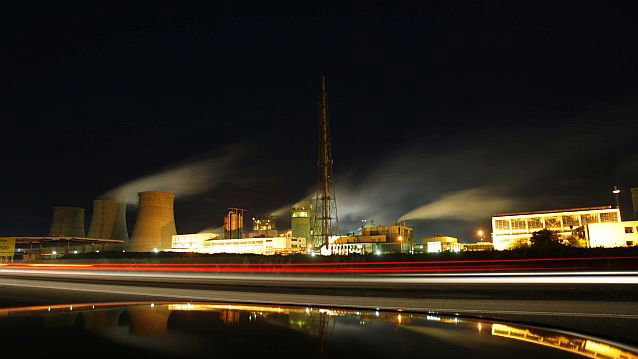
Azomures Targu Mures announced better financial results again this first quarter, as the price of chemical fertilizer remains high worldwide. The company posted 446 million lei (EUR100.4 million) in first quarter revenue, up 9.3% on the same time of 2011 and RON46.5 million in net profit, up 5.2%. Under the circumstances, the net profit margin remained above 10%.
Azomures has become one of the largest and most profitable companies in Romania over the last few years without making significant investments in production facilities, but benefiting from a favorable international market as well as from government aid, which allowed chemical plants to use only domestically produced gas since the end of 2008 through October 2010.
The price of domestically produced natural gas is capped at RON495 per thousand cubic meters by the government and is thus three times cheaper than the imported gas. This step allowed fertilizer makers (Azomures and the plants of Ioan Niculae) to keep going in 2009 when the market collapsed and return to significant profits in 2010, when fertilizer prices started rising abroad.
Although the incentive stopped being offered to fertilizer producers in the third quarter of 2010, they are still partly subsidized by the government because they use a mix of imported and domestically produced gas, spending less on a gas than they would if they used only the imported fuel.
The main profit growth driver is the trend of the fertilizer prices on the international market, considering Azomures exports most of its production. It exported 65% of it in 2011. In the first quarter of 2012, the average price of urea, used as a reference for the fertilizers in the region stood at $389/ton, 10% higher than in the first quarter of 2011 ($354/ton). More important, however, is that prices bounced back after a significant adjustment at the end of last year.
“The main driving factor has been strong northern hemisphere demand for spring application, as purchasing activity was low earlier in the season,” says Europe’s largest fertilizer maker, Yara, in its first quarter report for this year. The price was also driven by the low supply coming from the Middle East (Qatar and Egypt) and by China’s lower exports.
The price of fertilizers is also influenced a great deal by the grain prices and the amount of land cultivated worldwide. The higher the grain prices, the greater the land cultivated and implicitly the demand for fertilizers.
“Supply and demand fundamentals in most agricultural markets continue to support increased use of fertilizers. According to USDA estimates, global grain production during 2011/12 will only match consumption, implying unchanged grain stocks despite strong incentives throughout 2011 for farmers to expand production. Assuming continued growth in global food consumption, the world needs another record grain crop in 2012 in order to prevent a further inventory decline,” Yara’s report reads.
Another factor that influences fertilizer prices is the oil price. That is because the urea used in fertilizers as a source of nitrogen is derived from processing natural gas, whose price is tightly connected to the oil price, while the phosphorus fertilizers are made from minerals whose mining and processing is energy intensive, therefore the rise in oil price drives costs up. This was most clearly visible in mid 2008 when a surge in oil price to $150 per barrel drove urea prices through the roof to an all time high of $700/ton.
As long as the oil price stays up, so do the fertilizer prices, which is what Switzerland’s Ameropa must have thought when it bought the controlling interests in Azomures last year.
Azomures was trading for RON2.09/share on Tuesday and its market capitalization stood at EUR233 million. The fertilizer producer is one of the most valuable ten companies on the stock market and is among Romania’s fifty or sixty most valuable companies. (EUR1=RON4.4411)
(English version by Loredana Fratila-Cristescu)