
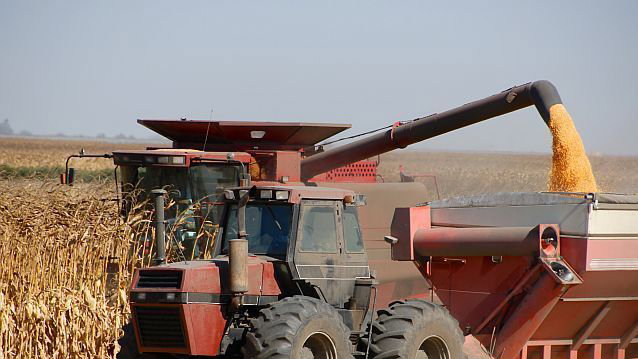
An abundant grain harvest is very important for Romania’s economic growth because agriculture has been one of the most dynamic sectors of the economy over the last few years.
Farmers are now talking about downwards revisions, about soil humidity being close to zero and about a crisis considering no rain is expected in the major farming areas of the country for the next few weeks. Romania’s total grain production had been estimated at 16 million tons this year, up 40% on 2012, which was a rather bad year.
“A month ago I would’ve said I’d get five tons of wheat per hectare (almost double the national average i.e.) and now I may not get anything. Estimated harvest has shrunk by 30% in a single week,” says Gheorghe Lamureanu, manager of Agro Terra Import Export in Constanta, a company that farms 1,200 hectares of arable land. “The crop looked magnificent until May 1 but now the soil water reserve is minimal.”
These are first negative signs for the agricultural business since the beginning of the year, after reports showed plants had come out of the winter fine and the harvest was expected to be good.
An April report of the European Commission noted that high temperatures in the spring and the mild winter had caused wheat, barley and rapeseed to grow faster than they should have. The northwestern part of the country saw the heaviest rainfall from March 1 through April 15, 100 mm/sqm, followed by the eastern and southeastern parts of the country, 50 to 100 mm/sqm and 20 to 50 mm/sqm.
Crop development led to first estimates indicating a total harvest of 6 million tons of wheat, 1 million tons of barley and 360,000 tons of rapeseed.
Farmers are now saying those estimates are no longer valid because of the hot weather of the last two weeks. Most initial calculations no longer apply, either.
“I had 200 hectares of rapeseed and lost it all, I had to replace the rapeseed with mustard and coriander to cut my losses. Unless the rain helps us, we’ll go bankrupt,” Gheorghe Lamureanu says.
Negative farmer estimates come after a 2012 that was a rather bad farming year because of the drought, which halved the grain harvest. After a record farming year in 2011, when farmers harvested 20 million tons of grain, last year the harvest was down to 11 million tons.
“A month ago I could have hoped for 6 tons of wheat per hectare, and now I should get only 5 tons/hectare. The losses could be even heavier and come after a difficult droughty 2012, which continues even now,” says Valeriu Calin, manager of Agro Ceres, a company farming 500 hectares of land in Buzau County (SE Romania).
The only weapon against drought is irrigation systems, but the infrastructure built before 1990 cannot be used for all the local farmers’ crops. Only 120,000 hectares were irrigated last year or 1.4% of the total arable land. As a result of various problems such as the long distance from a water source only 14% of Romania’s arable land can be effectively irrigated. The equipment built until two decades ago is energy-intensive and in many areas part of the infrastructure was destroyed.
The Agriculture Ministry started a project two years ago and announced it was looking for foreign investors to help build the Siret-Baragan canal, but no deal has been signed so far. The canal would allow irrigating several hundred thousand hectares in the south of the country at very low costs. The project should require EUR2.5 billion to EUR3 billion to implement.
Meanwhile, the authorities are offering a line of credit for farmers to access EU funds of up to EUR1 million to retool water pumping equipment using the current irrigation infrastructure.
(English version by Loredana Fratila-Cristescu)