
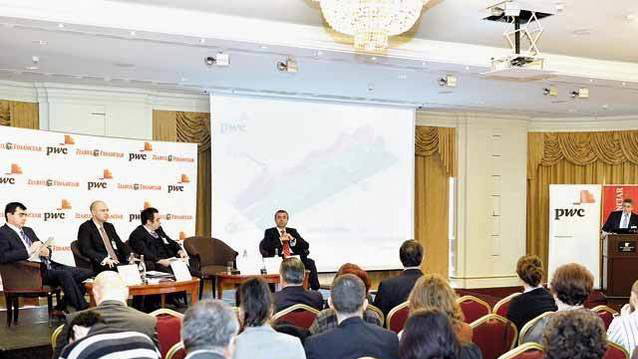
This is one of the conclusions of the conference “How economic growth and job creation can be stimulated through fiscal measures,” organized by audit and consulting firm PwC in partnership with Ziarul Financiar.
The conference was attended by Dan Manolescu, secretary of state in the Finance Ministry, Peter de Ruiter, partner, Head of Tax and Legal Services, PwC Romania, Daniel Anghel, partner Indirect Taxes, PwC Romania, Cristian Nacu, partner Enterprise Investors, and Anda Rojanschi and Dan Dascalu – partners D&B David si Baias, the law firm affiliated to PwC.
The reduction of social security contributions would be welcome considering how burdensome labor taxation is in Romania, and the measure could lead to a rise in private sector investments.
The reduction of social security contributions has been requested for a long time by the business world and has been supported by analysts’ numbers.
Even the representatives of the International Monetary Fund have many times brought up the need to adjust social security contributions (CAS), but only if an alternative solution is found to make up for lower budget revenues. Social security contributions are the main source of money for the consolidated budget.
“Romania has remained one of the countries with the highest levels of social security contributions. This is very worrying for the business world. It is necessary to cut social security contributions and cap health insurance contributions,” said Mihaela Mitroi, Fiscal Consultancy partner of PwC Romania.
Dan Manolescu, secretary of state within the Finance Ministry, relies that the reduction of social security contributions is a “commitment made”. He explains that this year the Finance Ministry will make a complex analysis of the entire social security system.
“In its current form, the social security system allows migration from one area to another. The entire social security contributions system needs to be analyzed and restructured so as to discourage such migration,” said Manolescu, son of the former secretary of state in charge of taxation, Maria Manolescu, who worked on the first form of the Fiscal Code in 2003-2004. In Romania employers pay social security contributions of 28.7%, while employees pay 16.5%. Whereas in Bulgaria companies pay 18.2%, while employees contribute 12.1%.
Peter de Ruiter, partner, Head of Tax and Legal Services, PwC Romania, says the level of tax collection in Romania is much lower than in European Union countries.
PwC consultants ask for coherence and predictability of the fiscal system, and for the fiscal authorities to consult with businesspeople and fiscal consultants when they make changes to the legislation.
The authorities modified the Fiscal Code virtually overnight at the beginning of this year, taking both business people and fiscal consultants by surprise.
“I don’t want any more major changes. (…) It scares me to hear that politicians are making laws in the library. Laws need to be made by practitioners. A simulation of laws’ medium and long-term effects must be done across all levels they impact. Otherwise chaos ensues,” says Cristian Nacu, Enterprise Investors partner.
(English version by Daniela Stoican)