
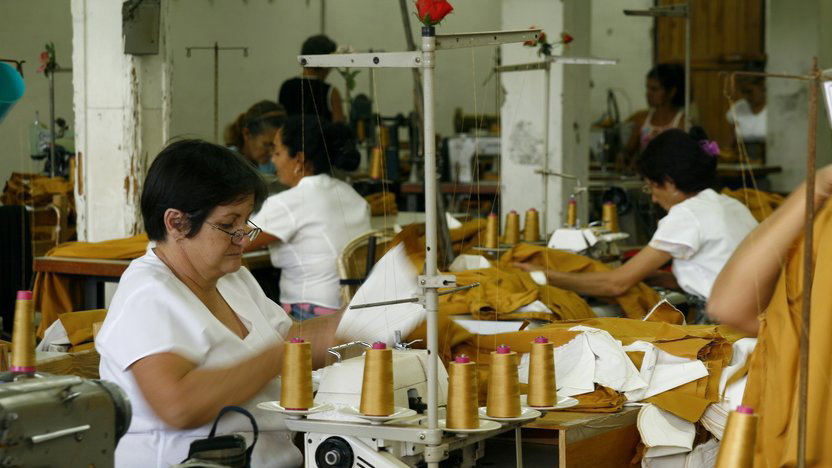
The plants employ almost 10,000 people and posted about 770 million lei (EUR175 million) revenue in 2013, according to the latest publicly available data.
All production facilities work for H&M but few of them have the retailer as their sole customer, so they also make clothes for other big names, like Inditex (Zara), C&A, Hugo Boss and Max Mara. H&M works with both clothing manufacturers and with companies specializing in embroidery and making and printing fabric.
“We came to Romania many years ago for the expertise in dressmaking and handicraft of the local plants,” says Catarina Midby, sustainable fashion advisor with H&M.
Romania being close to home (Sweden) and the competitive wages helped, as well, she added.
H&M’s sustainable fashion department handles the relations with suppliers, so a team audits each plant two or three times a year. The department also negotiates with the authorities and the owners of the plants to raise the wages of their employees in the supplying countries be they in Asia, Eastern Europe and Northern Africa, H&M officials say.
Catarina Midby says H&M wants the employees in the plants working for the retailer to be paid fair wages by 2018, but would not provide any details about what that means, merely adding that H&M is not the main actor in this process, as the decision ultimately rests with the plant owners and authorities.
H&M tries to help by placing orders throughout the entire year to avoid peaks and valleys, thus cutting down overtime. It also tries to be the sole customer of some plants so as to be able to analyze the whole process. It started doing so in Asia and Romania will follow, Midby said.
Dorel Simiz, who owns Pandora Prod together with his family, one of the leading local apparel manufactures and one of the main local partners of H&M, has previously said the busiest time of the year for the sector is May-December. To be able to ensure steady flow of orders and thus pay its employees, the manufacturer started offering discounts to those customers placing orders outside that period.
About 80% of the employees in the plants working for H&M are women, according to Catarina Midby. H&M has 850 suppliers (companies that have their own plants and also subcontract work to smaller companies), which work with a much greater number of plants. Catarina Midby says H&M is willing to pay more for the employees of the plants to get higher wages, without providing any figures.
Textile industry employees earn some of the lowest wages in Romania. The financial crisis and the fast rise of the Asian markets led to the loss of more than 120,000 jobs in the textile, clothing and footwear industries in 2007-2014. The wages of the more than 220,000 employees left in those industries rose by almost 80%. The gross average wage reached RON1,610 last year, but is still about 30% lower than the average.
Romanian plants working directly with H&M, however, pay gross average wages of up to RON2,220, closer to the average wage in the country and double the wages those working under toll manufacturing contracts get. H&M’s partners are usually big companies with hundreds or even more than 1,000 employees and tens to hundreds of millions of lei in revenue.
Most subcontractors working with H&M are located in Moldavia, and more than one third of the 30 plants operate in Vrancea County of that region, which is one of the poorest in the country, hence the lower wages. The lack of foreign direct investments in other industries such as automotive and construction have turned Moldavia into an apparel manufacturing region.
(English version by Loredana Fratila-Cristescu)