
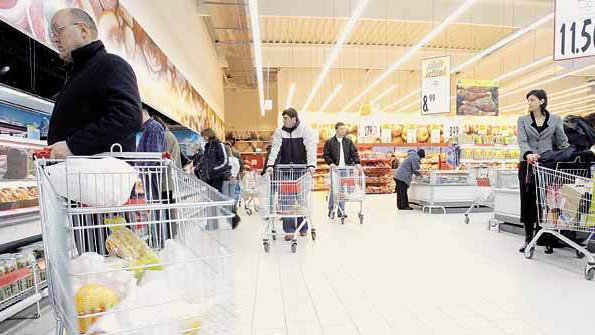
Job instability, the lack of wage rises in the private sector and the decline of public and private investments are the main factors that prompt Romanians to be increasingly cautious and less willing to spend money.
Consumption fell 3.3% in May against the similar month of last year and stagnated in the first five months, after last year it had managed to return to growth of 3.3%. Moreover, perspectives are not optimistic.
“If we look at the figures that indicate a decline in consumption in the first part of the year and at how concerned people are about the price increase or about their job stability over the next 12 months, we can’t expect signs of a consumption rebound in the second half of 2013, either,” Dumitrescu says.
Foreign direct investment fell 37% in the first five months of the year to EUR414 million against EUR656 million in the similar period of 2012. During the same interval, public investment fell 8.5% to 6.1 billion lei (EUR1.35 billion).
Under the circumstances, Andi Dumitrescu explains that Romanians are reluctant to spend money. According to the consumer confidence barometer, one of the indicators of the state of consumption, Romanians are the most pessimistic Europeans.
“Romanians are not willing to change their home or car and for good reason.” The executive says GfK studies on consumer confidence show Romanians are increasingly less willing to invest in durable consumer goods in the next year, especially in electronics and home appliances.
Also, only 3% of Romanians say they intend to buy or build a home in the coming period. Only 6% plan to buy a car. In 2012 6% of Romanians surveyed intended to buy a home and 9% planned to buy a car.
“These percentages have never been so low in the 10 years since GfK has been putting together the Consumer Confidence Barometer for the European Commission.”
Around 40% of the total occupied population earns less than RON1,500 (about EUR340) per month, which doesn’t allow them to bring money into the market.
“One continues to bet on spending cut measures, which is why at macroeconomic level we are in a vicious circle. No measures are taken to encourage investments and the economy needs such measures,” Dumitrescu says.
The market research company monitors a sample of 3,000 households, and analyzes both the evolution of consumption and trends.
Since January the company has been using scanning devices installed in people’s homes. After each shopping session, the members of the monitored households scan the barcodes of all FMCG products they buy daily. The sample is representative for the country.
(English version by Daniela Stoican)