
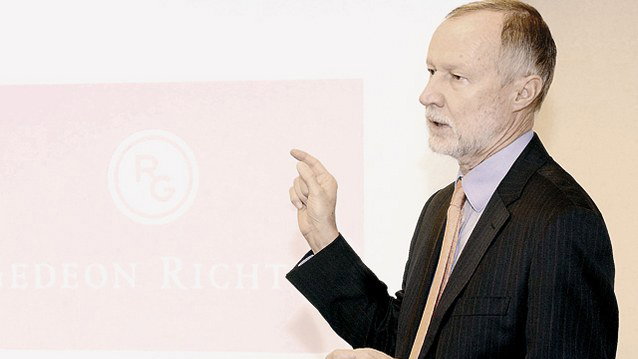
Hungarian-held Gedeon Richter, a EUR1.1 billion business a year, is the only integrated pharmaceutical company in Romania. It has manufacturing operations (Gedeon Richter Romania SA), import, distribution (Pharmafarm) and retail (Farmacia Richter).
Things are difficult in Romania but not more difficult than in Hungary. Romania’s main problem is the payment delay by more than one year, Erik Bogsch said. He meant the pharmacies get paid for the subsidized drugs they sell more than 300 days after the sale date, which creates problems for the entire distribution chain.
The Hungarian group started developing its business in Romania via acquisitions in 1998. This country generates about 12% of the EUR1.1 billion revenue of the group. In 1998, Gedeon bought the drug plant Armedica in Targu Mures (central Romania) and ten years later decided to consolidate its position on the segments it did operate on, i.e. distribution and retail, via acquisitions.
Distribution was consolidated by the merger of two companies Dita Import Export and PharmaFarm, acquired in 2006 and 2007. Gedeon Richter applied the same strategy with pharmacies, grouped together in a network of about 120 branded as Farmacia Richter.
Asked whether he was considering selling part of the operations in Romania, Gedeon Richter’s CEO said he had no such plans for the time being. He added that Romania was the second most important market after Hungary in terms of development.
The business is stable in Romania; the group is not losing any money but also not making any, which is quite a feat in itself, Bogsch said, who is confident the market will improve after one or two difficult years.
The CEO of the Hungarian group said one of the problems he was facing was the clawback tax, describing the system in Romania as ‘unfair’ to cheap products, which causes losses.
The clawback is tax levied on the pharmaceutical industry and is calculated as a percentage of the subsidized drug business. Pharmaceutical companies have challenged it, saying the 30% level is very high.
The Romanian operations account for 12% for the group’s revenue, compared with 14% in 2010. Erik Bogsch explains this was due to the decline in the distribution business.
The group’s total revenue in Romania stood at EUR129.6 million last year, down 5.6% due to the distribution and retail decline.
(English version by Loredana Fratila-Cristescu)