
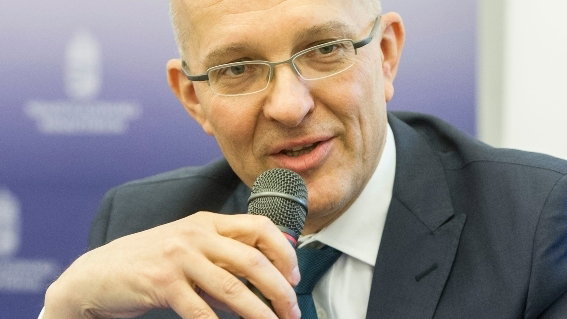

“In the future, the development of the energy sector will take the form of distributed production. This means building an electricity and heat generation unit close to consumption locations instead of building several very large capacities,” says Stracar.
He specified the pluses of this form of energy generation are the relatively low cost of a small capacity electrical station, the ability of this station to easily adapt to energy demand and the smaller transportation losses, given proximity to consumption locations.
In Romania, General Electric provided the equipment for two large energy production capacities, namely the 600 MW Fantanele-Cogealac wind park and the 860 MW Brazi gas-based station of OMV Petrom. However, Peter Stracar showed the Romanian energy field has a solid “backbone” and new investments should be channeled toward replacing obsolete capacities.
One of the applications of distributed energy production relates to city heating. Another field with a good potential as regards distributed generation is industry. In Romania, some companies have already invested in their own small-scale energy production.
“The agricultural field can use biogas, which I believe has a very good future in Romania and is an independent source of energy”. Stracar underscored that one of the pluses of renewable power is that the used resource does not come from imports, contributing thus to the country’s energy security.
Peter Stracar has run GE’s Central and Eastern Europe activities since 2013. In the region, the US group has around 26,000 employees, 18 production units and five technology centers and owns three banks.
In Romania, the group holds Unison Engine Components Bucuresti, the former Turbomecanica, and GE Medical Systems Romania.
In 2013, the group became the owner of Lufkin Industries, the US producer of oil industry equipment, which holds a plant near Ploiesti.
(English version by Catalina Apostoiu)