
On the other hand, the official of the group that has invested EUR160 million in wind power in Romania requests that the authorities in Bucharest leave existing investments out of the changes made to the clean energy support scheme.
As for the natural gas sector, which makes up most of the business of the group, Cirelli believes Russia will still have a lot to say in the area, after the Nabucco project fell through and left Romania with no alternative to Russian gas.
“We have sold a number of businesses, for instance our participation in Slovakia, in the gas business called SPP. We have also sold a participation in Brazil, where we are currently building the biggest dam in the country,” Jean-Francois Cirelli said.
The half-year report the company is due to publish in a few weeks will show it is on track with the EUR11 billion divestment program. “There is no divestment contemplated in Romania,” he added.
Jean-Francois Cirelli, 55, has been running the European operations of GDF Suez since 2008, when the group was formed by a merger of Gaz de France and Suez. Cirelli had been chairman and chief executive officer of Gaz de France prior to the merger and on various occasions served as advisor with the French government, which now owns 36.7% in GDF Suez. Cirelli was in Romania for the official two-day visit of the French Prime Minister Jean-Marc Ayrault.
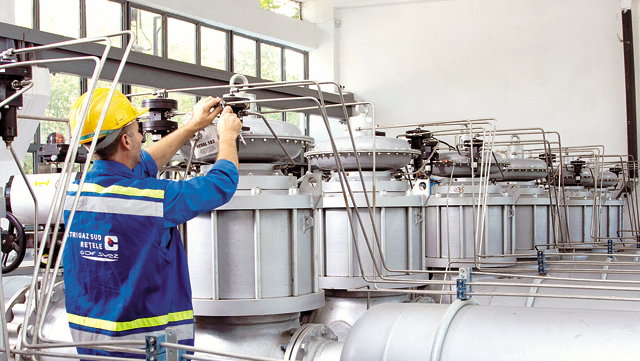
GDF Suez owns the former Distrigaz Sud, natural gas supplier and distributor for the south of the country, including Bucharest, and also has energy trading operations. GDF Suez Energy Romania posted 4.04 billion (EUR0.91 billion) revenue in 2012, while net profit stood at RON354.7 million.
“(…) for us, GDF Suez, Romania is a key country. We have a big presence in Romania, we have invested about EUR800 million since 2004.”
The company started with 1.1 million customers and now has more than 1.4 million. Investment prospects in the natural gas sector, without taking major projects into account, amount to more than EUR300 million over the next five years, Cirelli said.
GDF Suez has also invested about EUR160 million in renewable energy in Romania. It has a 48 MW wind farm in Gemenele, Braila County (SE Romania) and will also inaugurate another 50 MW farm in Baleni, Galati County, by yearend.
As renewable energy investments have been driven by various support schemes throughout the world, the French executive says his company is not happy with the changes of the support scheme in Romania. The scheme was enacted in 2008 and was one of the most generous in Europe.
Romania has seen more than EUR3.5 billion investment in the sector since its enforcement in 2011, but the burden was put on consumers’ shoulders, which have to pay the clean energy cost on their electricity bill.
“It’s always a problem when you touch legislation, which has been the basis of the decision of your investment. It’s important to give a very stable framework for the investor otherwise it would be complicated for us to continue to invest in the country. I can understand that sometimes schemes are too generous (…) but that (the changes i.e.) has to be for the future,” Jean-Francois Cirelli said.
He added GDF Suez would request a grandfather clause put in the law when the Parliament resumes work in the fall (September), exempting existing plants from the modifications of the support scheme.
(English version by Loredana Fratila-Cristescu)