
Unlike household loans, where banks’ offers are standard and published on their websites, for corporate financing banks’ offer is customized based on the field of activity, the risk profile, ownership and the track records with the bank. So there are no concrete reference levels for companies’ financing costs, which start from 6% per year or even less for sound companies like Petrom or Romgaz, which can be even less risky than the state. Interest rates can reach 8%-10% a year for solid companies with Romanian shareholders, and climb above 12%-14% a year for indebted companies, with a high risk profile.
The development of the bond market could make companies’ financing costs more transparent and could help free Romanian businesses from the “rule” of banks.
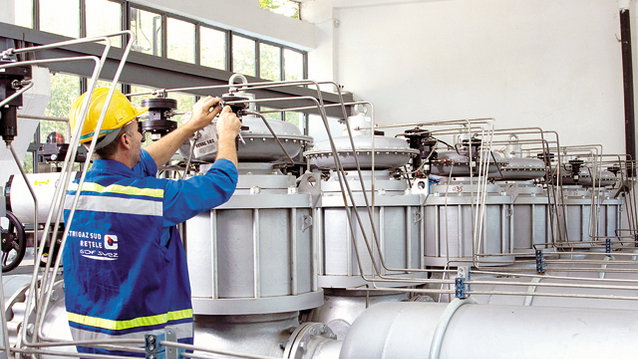
GDF Suez Energy issued 5-year bonds worth 250 million lei (EUR55 million) at a fixed interest rate of 7.4% a year. So the company’s financing cost is 1.2% percentage points above the 12-month reference interest rate (ROBOR).
Specialists say this can be considered a benchmark for companies with a similar risk profile. “An yield of 7.4% is clearly a benchmark, but for companies with a strong group behind them and with a triple A rating, not for a typical Romanian company,” says Doru Lionachescu, managing partner of investment boutique Capital Partners.
He says a company such as GDF Suez Energy, part of French-Belgian group GDF Suez, can get cheaper financing in euros and even in lei, but that this bond issue is a test to see whether in a difficult situation the company can attract financing from the local market.
“If something bad happens with Romania and the parent company cuts financing lines, they want to know if the market is deep enough for them to gather funds. I think all multinational firms will look very carefully at the details of this bond issue,” Lionachescu said.
Consultants say the GDF issue should be followed by a few more over the next few months, to get price references and only then one could speak about a burgeoning market of corporate bonds in Romania. This would bring down the costs of financing through corporate bonds and would offer a real financing alternative to local companies, which are currently dependent on bank loans.
For instance, a company such as GDF Suez Energy, which is part of a multinational with a turnover of EUR90 billion, should get financing at costs close to those of the Romanian government. The state currently sells debt at annual costs between 5.8% and 6.2%, depending on the maturity.
“I expect interest rates to decline for a company such as GDF. An argument would be that the level of risk of GDF can be considered lower than that of the state,” says Matei Paun, managing partner of mergers and acquisitions consultancy BAC Investment.
So far companies have preferred to get financing from banks rather than try bond issues because conditions have been more advantageous.
The lack of a bond market makes such financing more expensive at present than through banks, where a company the size of GDF Suez can borrow in lei at interest rates of 6%-7% a year.
For Romanian companies not backed by an international group, but with a solid financial position, costs of borrowing from banks currently range between 8% and 10%.
“The real test of the bond market will be the launch of a bond issue from a Romanian company with no foreign shareholders and without a very good rating. Such an issue could in a first stage be partly guaranteed in order to cover some of the risks,” explained Lionachescu.
More liquidity on the bond market would drag costs down, while banks are less and less willing to grant financing and are increasing costs.
In addition, bonds entail no additional costs, such as the administration fees that banks charge and which can be modified over the duration of the contract.
(English version by Daniela Stoican)