
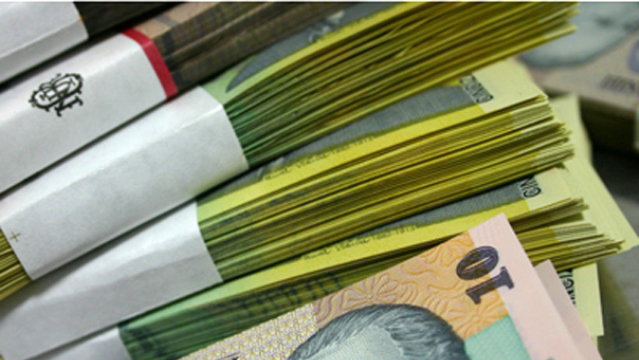
The money mostly went towards offsetting previous years’ losses and towards compliance with the prudential requirements.
The local subsidiary of Volksbank, on the sale of which the group signed an agreement with Banca Transilvania at the end of last year, got the highest capital increase, RON1.4 billion. Volksbank posted RON460 million loss in 2013 alone, due to risk provisions.
The non-performing loan problem was compounded by the lawsuits with its customers over abusive loan contract stipulations. Volksbank also has a significant portfolio of Swiss franc loans and is looking for a solution to covert those into leu or euro loans at a 25% to 30% discount, which means it is taking a loss and needs capital.
Another bank that got money from its parent bank was Turkish-held Garanti, which received RON69 million. Garanti posted profit last year and the capital increase was most likely needed to fuel its expansion plans in Romania.
Austria’s Vienna Insurance Group (VIG) operated the highest capital increases in the insurance sector. It injected RON272 million in BCR Viata, Asirom and Omniasig in January-November or 72% of the capital increases operated by all insurers.
VIG had to bolster the local business, which posted one third of the local market loss in 2013. BCR Viata, restructured last year, got the most money, RON111 million. Asirom and Omniasig got RON108 million and RON53 million. Asirom posted a record loss of RON250 million in 2013, while Omniasig more than RON200 million.
Romanian International Bank (RIB) now owned by Poland’s Getin Holding and insurers Fata and Euroins, too, operated significant capital increases. Euroins was required by the Financial Supervisory Authority to increase capital to comply with solvency and liquidity regulations.
Its owner, Bulgaria’s Eurohold, contributed RON19 million to Euroins capital in January-November, as part of an agreement to address the problem with auto liability insurance claim settlements.
Germany’s Gothaer, too, increased the capital of the local subsidiary by RON16 million.
The banking system had to deal with a high non-performing loan ratio, which peaked at 22% last spring but eventually went down to 13% at the end of the year. The insurance market has been in the red for eight years now.
(English version by Loredana Fratila-Cristescu)