
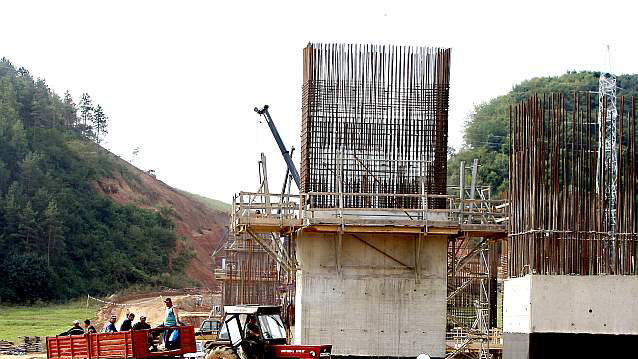
The build started in 2004, when Romania and U.S. constructor Bechtel signed a EUR2.2 billion contract for 415 kilometers of highway, of which little over 10% has been completed so far.
Romania spent 5.6 billion lei (EUR1.2 billion) on a segment of just 52 kilometers that took seven years to build, more than half the sum it was supposed to pay for the entire road.
In fall this year, the Government decided Bechtel will continue works just on the sections it has started and the remainder would be put up for auction and hopefully get EU funding. The Transport Ministry, however, has not set a deadline for when the road should be finished.
The project’s technical specifications reveal works will be completed in 2020 at the earliest but could take as long as 22 years, until 2026.
According to the document which lays down the scheduling of payments for funding and maintenance costs, Romania will spend another RON2.3 billion over the next four years: RON431.3 million in 2012, RON651.2 million in 2013, RON352.6 million in 2014, and RON866 million in 2015. The same document stipulates the state will pay a total RON4.8 billion after 2015, but doesn’t state a date for when works should be finalized.
Considering a maintenance cost of EUR4,500/kilometer during the winter season, according to cost standards approved by the Transport Ministry, and annual maintenance costs of RON24.4 million, the RON4.8 billion funding scheduled for after 2015 covers construction works until 2020 (if the annual funding stays around an annual RON800 million, as in 2015) or as many as 11 years, until 2026 (if annual funding stays at the current RON400 million, which the Government barely manages to cover).
From this standpoint, Romania’s highway is on a par with some of the biggest highways in the world, such as the Trans-Canada Highway (10,000 km), the Trans-Siberian (11,000 km), Australia’s Highway 1 (20,000 km), and the Karakoram highway (1,300 km), which links China to Pakistan and took 20 years to build, at an altitude of 4693 meters, which makes it the highest highway in the world.
From the point of view of quality, Romania has many other contenders according to the latest report by the World Economic Forum, and is struggling, but with not much success so far, to build better quality roads than those in countries like Namibia, Botswana, Sri Lanka, Rwanda, Trinidad Tobago, Tanzania, Uganda, and Burkina Faso. Poor road infrastructure is one of the main reasons cited by foreign investors avoiding Romania.
For $800 million, Morocco is currently building a 172-km highway that will cross the Atlas Mountains and should be completed by June 2013, while Germany builds over 1700 km of highway every year, at a rate of 3.5 km a day.
Contacted by MEDIAFAX and asked about the deadline for completion of works on the Transylvania Highway considering documents point to 2020 or later, the roads authority CNADNR only said sections of the road might become eligible for EU funding during 2014-2020 and completion deadlines would be revised after 2014 depending on financing sources.
The roads authority reminded Bechtel should finish a 64-km section of the highway in 2013, and two other sectors, of 8.7 km and 37.1 km respectively, contracts should be awarded next year and works are expected to be finished in two years.
Transport Minister Anca Boagiu said in May Romania will have 845 kilometers of highway “in a few years” following investments of EUR5.17 billion.
However, the ministry’s draft budget for the road infrastructure development program stipulates lower funding each year: from over EUR3 billion earmarked for this year, to RON2.1 billion in 2012, RON1.8 billion in 2013, and RON1.5 billion in 2014. On the other hand, funds assigned to pay for ministry employees’ trips abroad remain virtually unchanged compared to this year.
In the governing program, the Government has undertaken to propose a national pact for highway construction, to be funded with at least 1% of the gross domestic product. No such pact, which was supposed to include all the projects doable until 2020, has been yet proposed.
(English version by Oana Gavrila)