

The overall electro-IT market and the white goods market in particular have been among the hardest hit by the crisis, losing almost have of their value during this period.
Starting 2009, Romanians have become ever more reluctant in spending large sums and cheap lending dried out, so that people bought refrigerators or washing machines only when they strictly needed one, and the market froze.
“It is visible Romanians have regained their confidence and they are more willing to spend. Also, a consumer lending rally can be felt, a reason why the strongest growth was posted by the white goods category, by 15% this year”.
This points to the industry’s health, believes the Romanian executive who built his entire career in the electro-IT field, starting from the position of sales consultant.
“The market was being educated in 2005-2006, a period of booming consumption. Now, the market is educated, and so are consumers. We (market players i.e.) also stood to learn from the crisis as during those periods of incredible increases we thought of ourselves as gods on earth”.
The crisis, believes Dragos Sirbu, is behind us, and the current period is the new reality. The positive trend will maintain provided no major crisis, such a war in Ukraine, emerges.
Thus, the market will expand by around 7% this year, a pace similar with last year’s, when electro-IT sales reached EUR1.7 billion. Of the overall market, around 40-45% is held by specialized retailers (such as Altex, Domo, Flanco), 25% by hypermarkets, supermarkets, discount and cash&carry stores, and the rest of 5-10% to small independent chains, which suffered the most during the crisis.
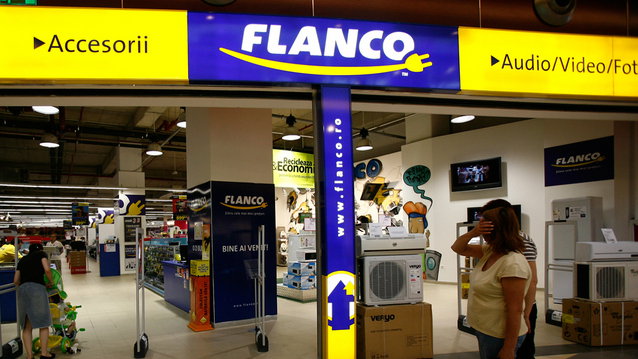
Flanco has budgeted a 10-11% sales advance this year. The retailer ended 2013 with revenue of 616.6 million lei (EUR140 million), up by a little more than 1% on the year, but way below the company’s initial expectations.
During the same period, though, profit rose five times, to RON1.3 million (EUR0.3 million). In recent years, the company has made sweeping cost restructuring moves to return into the black.
“Pure retail, our core business, posted stronger growth, but there were other categories, such as business-to-business, which lagged behind,” explains Dragos Sirbu Flanco’s 2013 figures, without providing further details.
However, he specified the company plans to develop this business segment as well as it has growth potential.
In the electro-IT industry, individuals still operate the bulk of acquisitions on the market, says Dragos Sirbu. The market rebound was also supported by the deicing of consumer lending, adds Sirbu.
Romanians are still watching prices closely, but they’re also looking at products’ technical features. “The online segment, with an average increase of around 10%, is a source of information on one hand, as well as an acquisition space, on the other one. Our growth on this segment is in line with the market average”.
Flanco has 81 physical stores. The retailer plans to open another four, with the number likely to rise depending on opportunities. The company is looking both at front-street locations and shopping centers.
“We’re seeking spaces of 800-1,000 square meters”. The retailer also shut down one store in Targu-Jiu and is further analyzing its network so that, depending on the efficiency of each store, there can be further shutdowns.
As regards rents, Dragos Sirbu says they have fallen, but not deeply enough. The company is permanently in talks with space owners.
Flanco boss says his main objective is to expand the business and this could be done through an acquisition. “We do not want to sell, but to buy”.
Sirbu previously worked for Altex, leader of the electro-IT market. Before joining Flanco, he was the chief executive officer of consumer lending company Credex.
Flanco revenue plummeted during the crisis and in December 2009 the retailer entered insolvency. Flanco exited insolvency in 2011 after the company’s healthy assets were transferred to Flanco Retail, which operates the store network.
(English version by Catalina Apostoiu)