
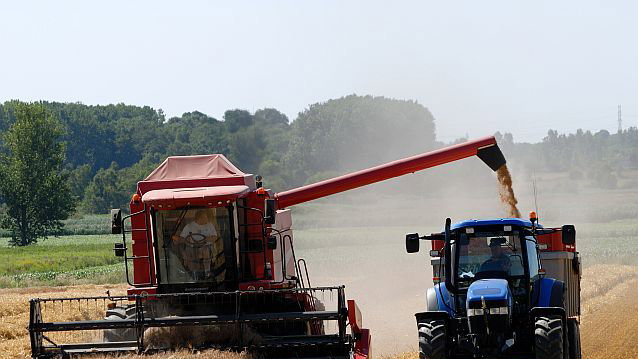
Although the agricultural sector has ended up boasting business of tens of millions of euros, the state is still reluctant to adopt a taxation system that can bring more money to the budget, and the short-term government of prime minister Ungureanu has not yet expressed any such intention.
“Farmland taxation is relatively low and on the other hand in grain trade there is probably high tax evasion. Given that agriculture is less taxed in Romania, a very good agricultural year does not necessarily mean a significant increase in budget revenues,” says Ionut Dumitru, president of the Fiscal Council, the institution that the Finance Ministry itself put in charge of making sure fiscal legislation is complied with.
Under the circumstances, the Finance Ministry prefers to leave aside the agricultural sector when it calculates the share of revenues to GDP, considering it too volatile a component and recommending an analysis of the detailed GDP structure for a fair comparison between the evolution of budget revenues and of GDP in nominal terms. The Finance Ministry also says the analysis should be made on budget revenues influenced by economic evolution, and not on all categories of the general consolidated budget.
The explanations of the Finance Ministry come after on Monday Theodor Stolojan, the leader of PDL MEPs, published an article saying last year the revenue collection rate declined because the share of revenues was limited to 31.8% of nominal GDP.
Nominal GDP was RON522.5 billion in 2010, and RON578.5 billion in 2011, a 10.7% increase. Nominal GDP corresponding to last year was revised upwards, from RON547 billion to RON578.5 billion, largely based on the contribution of agriculture (as a result of the exceptional agricultural production).
A simple calculation can show that last year the Finance Ministry did not manage to meet its target of revenues amounting to 33.3% of GDP, instead the percentage was just 31.4%, as results from an analysis published by ZF last month, after the updating of nominal GDP values for the past few years and for 2012.
But the Finance Ministry prefers a calculation in which budget revenues, EU funds excluded, remained at 32.4% of GDP, the same recorded in 2010, unless one includes production of agriculture, a less taxed sector.
(English version by Daniela Stoican)