
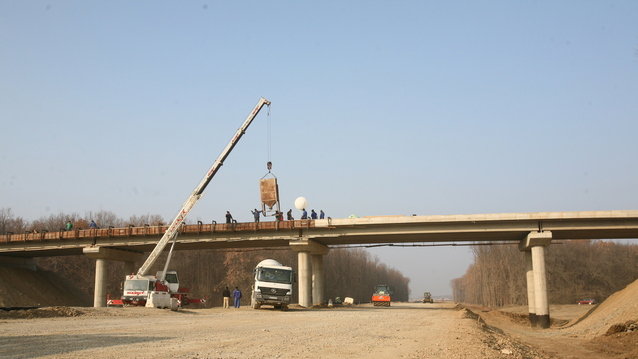
Regarded as the most expensive, most important and also most eagerly awaited infrastructure project in Bucharest in the last twenty years, the EUR240 million overpass was opened last summer. This is one of the most important victories of the Spanish company on the local market.
Sebastien Picaut, the 40-year old manager of the local subsidiary of FCC Construccion, estimated a slight increase in turnover for 2011, by almost 10% to EUR120 million, chiefly because of the revenue generated by the large projects that the company had going, such as the Timisoara-Arad highway (western Romania), the Constanta beltway (SE Romania) and the Basarab Overpass.
The company is on schedule with the projects it worked on in 2011, Sebastien Picaut says. FCC Construccion inaugurated a number of big projects in 2011 such as the Basarab Overpass in June and part of the Constanta beltway in July. It also completed the cable-stayed bridge in Otopeni on the Bucharest beltway and fully opened for traffic the Arad-Timisoara highway, which is 32-kilometer long and cost some EUR115 million to build. FCC partnered with Astaldi on this again and has some work left on the new highway to do.
The Spanish-held company says it will also complete rehabilitation of 100 kilometers of the Dej-Baia Mare (NW Romania) national road, which began in 2011 and was 50% done by December.
FCC Construccion also took on construction of subway lines in Bucharest last year. The Transport Ministry signed a EUR215 million contract for the building of the Raul Doamnei – Eroilor section (linking a district in the west of the city to the center) of the Line 5, with a consortium comprising Astaldi, FCC Construccion, Delta ACM 93 and AB Construct last spring. Work on this project should be completed by 2015.
The strategy of the local subsidiary of the Spanish builder entails diversification of the projects it takes on in 2012, so as to include railway infrastructure work. Its officials say FCC Construccion has been involved in a number of railway projects in Spain over the last fifteen years, a country that will become second leading in the world in terms of high-speed rail network (about 2,800 kilometers as Picaut says) this year.
Their plans stand chances of success considering that CFR SA, the state-run company, which manages the railway infrastructure of the country awarded Spanish-held FCC Construccion and Azvi and the Austrian-held Alpine an over EUR200 million railroad upgrade contract in December.
FCC is also looking at airport upgrade projects that will be tendered this year.
Sebastian Picaut is cautious in his estimates about this year’s revenue, saying it will be about the same as in 2011. He believes the construction sector in Romania has got potential, though. The premises for economic growth are there and the construction sector can be an important growth driver, he said.
(English version by Loredana Fratila-Cristescu)