
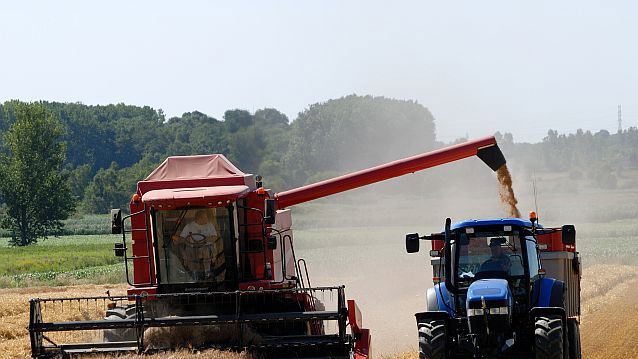
Agriculture will breathe life into the economy this year for the second year in a row. Industry will most likely be on the decline because of lower external demand, the construction sector will rebound in 3Q and 4Q, while trade could also grow, thanks to wages being restored in the public sector.
So agriculture remains one of the few drivers of the economy, with the money from selling the crops ending up in consumption, although agriculture remains one of the least taxed sectors of the economy.
The latest pre-harvest forecasts show that the overall production of grains will be slightly lower this year than last year’s record-high output, down by 1.4 million tons, but the impact on the economy will be close to the 2011 one thanks to the price increases amid high demand on international markets. Agricultural output was at a 5-year high in 2011 and second only to 2004 figures for the entire period since the fall of communism in 1989.
June estimates, the latest ahead of the wheat and barley harvests being gathered in barns or taken over by traders, show that Romanian farmers will produce 17.9 million tons of grains this year, down 7.2% against 2011.
“I estimate that the impact on GDP will be around 70% of last year’s level. The rapeseed crop has been almost entirely lost because of last year’s drought, but if it rains in the next few weeks, the corn harvest will approach last year’s output,” explains Sorin Dogaru, manager of the agriculture division of InterAgro, a business that exploits 50,000 ha of arable land and which last year had a turnover of EUR200 million.
The 1.4 million ton decline will be accounted for by the smaller wheat and corn harvests, according to June forecasts of Cocereal, a European organization of agricultural raw material traders.
Bank analysts’ opinions are divided as to the contribution of agriculture to this year’s economic growth.
Melania Hancila, chief economist of Volksbank, says agriculture will have a positive contribution to GDP formation, but because of the unfavorable base effect, growth will be one digit, significantly lower than last year’s rate, under the basic scenario.
On the other hand, BCR analyst Eugen Sinca believes after the exceptional production recorded in 2011, agriculture could have a zero contribution to this year’s GDP at best.
What agricultural production will be like
The wheat harvest is set to amount to 6.1 million tons, 15% less than the record-high production of 2011, with the decline being caused by the bad weather conditions recorded last autumn.
On the other hand, estimates for the corn harvest have improved since the beginning of the year. This comes after the areas dedicated to this crop have been increased by 100,000 ha, as some of the areas originally dedicated to rapeseed have been cultivated with corn.
Under the circumstances, Viorel Matei, president of farmers’ association FNAPAR, says farmers could salvage the economy for the second year in a row. Although harvests are lower than the 2011 highs, prices could make the difference and bring the contribution of agriculture to GDP to a similar level to 2011.
“The impact to GDP will be similar to last year or even higher because of the higher prices. Barley this year sold for EUR160-165 per ton and in 2011 the price was somewhere around EUR140-150 per ton. The situation is similar with wheat. Now, in full harvesting campaign, wheat prices are around EUR160 per ton and likely to grow towards EUR180 per ton,” Viorel Matei said.
Agriculture became in the second half of last year a true star of the economy after it grew faster than expected in the third quarter of the year. At the time agriculture’s contribution to GDP rose by 11.3%, this sector being one of the main contributors to last year’s 2.4% economic growth. Overall agriculture brought almost EUR19 billion into the economy last year, according to Eurostat data.
Whereas in 2011 the significant contribution to GDP of agriculture came as a result of harvesting larger amounts, this year data shows that agriculture’s contribution to GDP will remain solid as a result of the price increases.
However, in the absence of a highly-performing irrigation system, agriculture remains a difficult-to-predict sector, with final results being almost entirely dependant on this summer’s rainfall.
(English version by Daniela Stoican)