

There was no growth in exports in December compared with the same month of 2010. The decline of exports, one of the few drivers that kept the economy afloat over the last few years occurred right after telecom giant Nokia closed its phone-making plant in Jucu, northwestern Romania.
Only three months after the departure of the Finnish company, the monthly exports of Romania fell by one billion euros. At least EUR100 million of this amount can be considered as caused by Nokia’s plant closure. Imports, too, fell by 14% to EUR4.3 billion in the last three months of 2011.
“Exports were down in the last month of the year, but December is a short month. Seeing as imports went down towards the end of the year, as well, this trend cannot be fully attributed to the departure of Nokia. One needs to consider the slowdown of the European economy, too,” says financial analyst Dragos Cabat.
“The export trend over the following period is very much up to the European economy. Romania can boost exports by 5% this year.” Indeed, German economy, the largest in Europe, shrank by 0.5% in the fourth quarter of last year.
News of Nokia’s plant closure came as a total shock at the end of last September. The sudden departure of one of the largest exporters in the economy now becomes visible in official statistics.
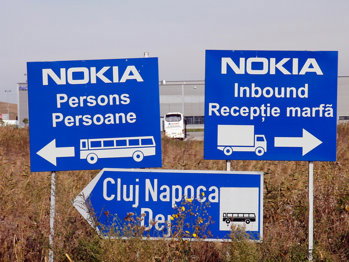 Back in September, when the Finnish phone maker still had manufacturing operations in Romania, the country’s exports amounted to EUR4.2 billion. In the following months exports started showing signs of a slowdown. They went down by EUR100 million in October and November each and lost another EUR900 in December, returning to the level of December 2010.
Germany’s Bosch and Italy’s DeLonghi have announced plans to move into the spot previously occupied by Nokia in Jucu, but it is still to early to tell whether they will manage to close the “crack’ Nokia caused in Romania’s exports.
“Nokia’s departure is not such a big deal, investors come and go. Other investors come and fill the void, but it remains to be seen how much they will export,” says Laurean Lungu, economic analyst with Macroanalitica. “Nokia did not have too high an added value in Romania, because although a major exporter, it was also a major importer.”
Central bank governor Mugur Isarescu early this week said that the decline of the local economy over the last few years had been due to the drop in foreign investment, adding that the domestic economy did not have the capacity to compensate for such “injections”. Foreign direct investment has gone from EUR9.5 billion to EUR1.5 billion over the last four years.
Nokia exported at least EUR1.4 billion worth of cell phones a year from Romania, according to ZF’s estimates. Its departure cut 3% of the country’s exports.
Things are even more complicated now as the exports are showing the first signs of slowdown and this year’s export growth target was set at 8%. To attain it, exports should increase by more than EUR300 million every month.
(English version by Loredana Fratila-Cristescu)