
The situation also has a negative impact on Metro, an about 5 billion lei (EUR1.12 billion) business with more than 5,500 employees, whose customers are precisely those small traditional retailers.
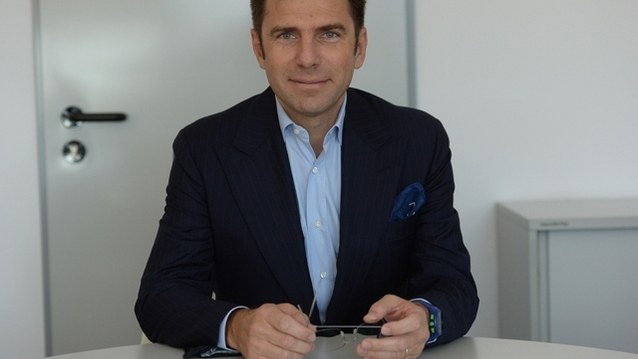
“We are trying to stop this shop closing spree by developing and supporting the LaDoiPasi project,” says Wilms, who started working for Metro in 1998 and has held various positions with the group both at Metro Cash&Carry and Real, Metro’s hypermarket division.
Wilms is the first executive in local modern retail to complain about retailers being allowed to build large format stores, such as hypermarkets, in city centers in Romania. Western markets require hypermarkets to keep to the outskirts of the cities.
Traditional retail has lost more than 70,000 stores since 1996 (when Metro arrived in Romania), the company’s officials say. There are about 150,000 traditional retail stores in the country at the moment, according to ZF data.
“I don’t think traditional retail can disappear, it is a very important part of the local economy that relies on small entrepreneurs, on family businesses. Those entrepreneurs generate a lot of the taxes collected by the state budget.”
Moreover, these small businesses provide certain services to end customers, which no modern retail store can provide. For instance, they know their customers by name, know their history and preferences. A supermarket cannot do that because it has too many customers.
Modern retail (cash & carry, supermarkets, hypermarkets and discount stores) currently accounts for 50% of the local retail trade, gaining ground through aggressive expansion year by year.
“It will be OK if the ratio remains 50%-50%. The only factors that can influence it are the authorities that issue construction permits in city centers.”
Modern retail started to develop in Romania in 1996 with the arrival of Metro Cash & Carry whose local operations are controlled by Germany’s Metro group and businessman Ion Tiriac.
Metro Cash & Carry was the local retail leader for 15 years from 1996 through 2010. In 2011, fellow German competitor Kaufland, which operates a network of discount hypermarkets, beat it for the first time. Kaufland posted EUR1.45 billion revenue in 2012.
Metro Cash & Carry’s sales started to shrink during the crisis, dropping from RON5.75 billion in 2009 to RON5.04 billion in 2012. Profit halved to RON66.5 million last year. Dusan Wilms says his company does not expect any major changes in 2013.
Unlike most modern retailers in Romania, which opened store after store to preserve their revenue growth, Metro chose to expand cautiously. Its latest two openings took place in 2011 and both were small Metro Punct stores.
“We only open when we feel there’s potential for new companies to develop. As the number of resellers (such as small shops on the ground floor of apartment buildings i.e.) is dwindling, there’s no reason to open more stores,” Wilms says.
The cash & carry format’s target customers are traditional retailers, restaurants, coffee shops and bars, not the consumers, who are served by hypermarkets, supermarkets and discount stores.
The number of restaurant customers has remained relatively constant as some closed and some new ones opened, Wilms says.
On the other hand, the number of small traditional stores has plunged, largely because of the aggressive expansion of modern retailers, which open convenience stores on the ground floor of apartment buildings in bedroom districts, once the exclusive turf of small retailers.
International networks are trying this way to grab as big a slice as possible of a market put at EUR7 billion to EUR8 billion a year.
The 12 modern retail networks in Romania overshot the 1,000-store mark for the first time this year. To help traditional retailers, Metro Cash & Carry introduced the LaDoiPasi franchise about a year and a half ago. So far, 626 stores have rebranded and joined the network out of 720 contracts signed. Metro contributes advice, while the storeowner makes the investment in rebranding and in arranging the store.
(English version by Loredana Fratila-Cristescu)