
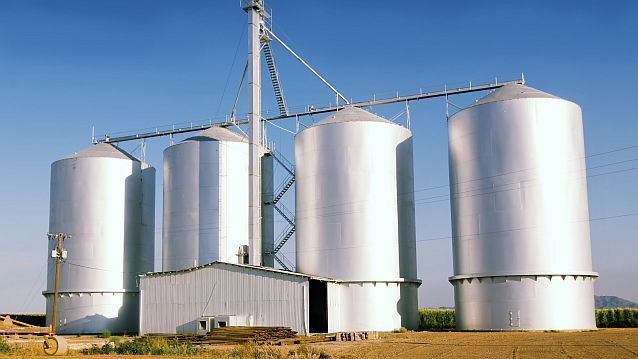
“The silo is already operational. We are currently doing consolidation work. The investment has been made through an EU-funded project – we received EUR2 million, while the rest were company funds,” said Lucian Buzdugan, general manager of the 55,000-ha farm on Insula Mare a Brailei.
Silos and storage facilities for grains have been one of the investment directions of Romanian farmers in the last few years as storage facilities allow them to make sure they are profitable. Basically by storing the grains, the farmers are not forced to sell them right after the harvest, when prices tend to be in freefall.
In fact data of the Agriculture Ministry shows that in the last four years agricultural companies developed silos and other storage facilities with an overall capacity of 2.6 tons in the wake of investments of EUR260 million, ZF has calculated. So the overall storage capacity on the Romanian market rose by 17% during this interval to 17.4 million tons.
TCE 3 Brazi plans to develop its storage capacity this year because although it is one of the largest agricultural producers in Romania, it does not have significant storage facilities. The company has a 15,000-ton facility exclusively for the storage of seeds in Braila, another 5,000-ton one for grain storage also in Braila and a 5,000-ton grain storage facility in Neamt county (NE Romania).
“We can extend the capacity of the recently built silo to 80,000 tons, which would require an investment of around EUR4 million. We want to reach storage facilities of 150,000 tons soon,” Buzdugan added.
He also said the company intends to build several grain storage facilities around the Insula Mare a Brailei island area in partnership with other local farmers in order to have easier access to the storage facilities.
Buzdugan said the company does not plan to become a grain trader for the time being, but does not rule out the possibility in the future.
“We will continue to sell to traders. We can easily transport the grains in 7,000-ton ships from here in Braila to Constanta, where it they are loaded into Panamax [large-capacity ships that can carry 50,000 tons of grains]. We can also sell directly, but only within the region in order not have high transportation costs.”
(English version by Daniela Stoican)