
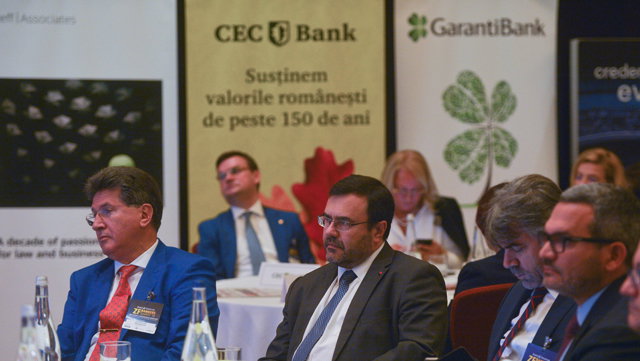
The banks’ strategy to rely on organic growth primarily, by gaining new customers, leaves room for private equity firms to play a greater role in the consolidation of the local banking system, and the approval US-held J.C. Flowers got for buying Piraeus signals Romania’s central bank could be more open to such deals, the partners specializing mergers and acquisitions with the largest advisory firms said at ZF Bankers Summit ’18.
“The consolidation of the banking sector can be done through private equity firms entering the market, and such an actor can be successful in Romania. I expect banks with a 0.5% to 0.7% market share to be acquired within a year and a half,” said Radu Dumitrescu, partner with Deloitte Romania.
“A small bank is currently involved in such a process. Banks with a market share of around 1% cannot stay on the market for decades, because they cannot handle mounting costs.”
Romania’s central bank has been rather cautious about private equity firms so far, but its approval for the US-held J.C. Flowers takeover of the local subsidiary of Greece’s Piraeus group, is a signal that reinforces the idea of a consolidation of the banking system with the help of private equity firms.
Three such firms are currently active in the banking sector of the country at the moment – Broadhurst, which owns Libra Internet Bank, J.C. Flowers, the buyer of Piraeus and Axxess Capital of Horia Manda, the shareholder of Patria Bank. UK’s Argo Capital is in talks to enter the local banking market by buying Leumi Bank and is awaiting approval from the regulatory authorities, the central bank included.
“BNR (Romania’s central bank i.e.) has been cautious about private equity firms so far. The legislation is very traditional, as well. It’s not easy to implement all the requirements on a different structure but getting the approval for Piraeus’ takeover is a signal,” Laura Toncescu, partner with KPMG, said.
“A private equity firm can come with a new perspective, a new strategy. Such investors will come to consolidate.”
The consultants attending this year’s ZF Bankers all agreed that the biggest challenge for an investor looking to a buy a bank in Romania is securing the approval of the central bank.
“Buying a bank in Romania is not hard, securing BNR’s approval is. The central bank does not look at the acquisition alone, it looks at the medium and long-term prospects, at whether the investor can support the bank in the future. This translates into a business plan thoroughly reviewed with the BNR, a significant financial support and experience in the banking system of another country that must be proven,” Deloitte’s Dumitrescu said.
Asked what would be best for an investor, buy a troubled bank or a stable one, consultants’ opinions varied.
Sebastian Mocanu, partner with EY Romania, said he would go for an ailing bank if he were a short-term investor and for a stable bank if he were a medium and long-term investor.
“On short term, I would buy a stable bank, and on medium and long term I would buy an ailing one to restructure. I think it makes sense to buy a bank with a less than 1% market share, that is the strategy of J.C. Flowers. J.C. Flowers wants to grow the bank in Romania through acquisitions and later sell it.”
On the other hand, Cornelia Bumbacea, partner with PwC Romania, believes it is easier for an investor to create a growth platform rather than conduct restructuring.
“I’ve hardly seen banking turnaround structures being successful. It is easier to build a growth platform rather a turnaround structure. There are still some banks with good growth platforms.”
ZF Bankers Summit ’18 was organized in partnership with Visa, Alpha Bank, CEC Bank, PwC, Garanti Bank, Loxon, Deloitte, Plaut, Mastercard, Idea Bank, Idemia, Advantage, AEGRM, Debt Collection Agency and Appello.
(English version by Loredana Fratila-Cristescu)