

The year 2011 came with the first signals of recovery on the Romanian footwear market, after 2010 saw the industry shrink both in terms of volume and in terms of value.
The local footwear market amounted to RON3.264 billion (EUR770 million), on a continuous downward path since 2007 (in euro terms), according to data of market research company Euromonitor International.
In the last four years, the industry lost around EUR400 million because of more cautious buyers, with lower disposable income. The number of pairs of shoes bought also declined from 26 million pairs in 2008 to around 24 million pairs last year, which amounts to an average of one pair of shoes bought per year, on which around RON130 are spent (around EUR30).
Considering that a pair of shoes priced on the medium and medium-high segment tends to cost upwards of EUR30, companies on the market have to opt for one of two strategies: either bet on high sales volumes and low prices, as is the case of Leonardo and Deichmann, or on above-average prices – Otter, Benvenuti and Musette.
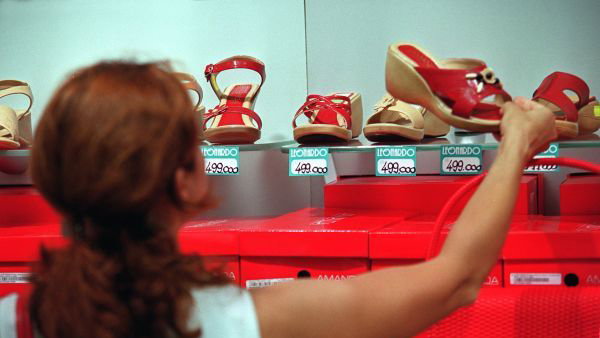
Leonardo, the largest footwear and leather products retailer on the Romanian market, with around EUR78 million in turnover last year, went insolvent at the end of 2009, and then positioned itself in the medium-low segment, setting a maximum price limit of RON249 (less than EUR60), VAT included.
But in 2011, the average retail price was RON70 (EUR16.5) and the minimum price reached RON9 (around EUR2), according to Leonardo representatives.
Relying on volume sales, the retailer, which owns a 140-store chain, has managed to sell a little over 326,000 pairs of shoes per month on average, i.e. around 11,000 pairs a day.
The same objective, high volume sales, has been pursued by German retailer Deichmann, the second-largest company on the local market, with over EUR27 million in turnover last year. The financial results of the two top-ranking companies show that last year Romanians relied on cheap shoes, with Leonardo and Deichmann making tens of millions of euros in turnover by selling high volumes.
Despite the financial crisis and the difficult international situation , footwear and accessories retailer Benvenuti recorded the best sales since the company’s establishment in 2010, after the turnover went up 31% to RON46.2 million (around EUR11 million), with the company returning to profit, according to Dan Pavel, the company’s founder and majority shareholder.
2010 was also a good year for Otter Distribution, with the turnover being the only financial indicator that recorded a decline against 2009. In 2010 the turnover of Otter Distribution amounted to RON64.7 million (EUR15.2 million), down from RON68.7 million (EUR16.2 million) in the previous year. After the company posted an operating profit in 2009, but a net loss of RON1.5 million (EUR0.35 million), 2010 was the most profitable year for Otter, with a net profit of over RON4.5 million (EUR1.1 million).
Filip Schwartz, majority shareholder and executive manager of Otter Distribution, which brings the top two best-selling footwear brands worldwide (Clarks and Geox) to the Romanian market, hopes for a 5-10% higher turnover in real terms at the end of this year compared with 2009. He also announces expansion plans for a new footwear store chain, Promenade, which he hopes will reach 10 stores by the end of 2012.
In turn, Musette, the company of the Batlan family, plans to expand this year. Recently having opened its third store in Hungary, Musette wants to go to Poland and the USA.
Cristina Batlan, Musette founder, intends to continue to open stores on the external markets, after the opening of the first New York store encouraged the company to open stores under a franchise agreement. She has already managed to take Musette shoes to Luxembourg, Israel and Bulgaria. Out of a total of 21 stores, 12 are located in Romania and nine abroad.
After opening new stores on foreign markets, Musette’s business went up to EUR5.6 million last year, from EUR5.1 million.
In turn, German group Deichmann, with a 37-store chain in Romania, announced at the beginning of the year it wanted to open ten new stores, according to the company’s website, after in 2010, when the economy pursued a downward trend and consumption fell by 5.3%, the company opened 15 new stores.
An explanation for the store openings announced by retailers could be the fact that the market is set to rise from EUR777 million last year to EUR1.5 billion by 2015, and to EUR2.4 billion by 2020, according to Euromonitor.
(EUR1=RON4.2419)
(English version by Daniela Stoican; Editing by Radu Bostan)