
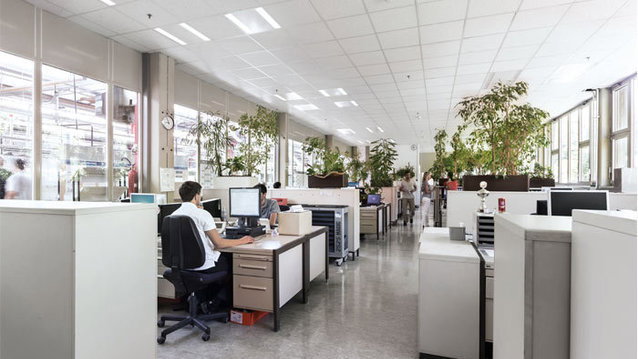
The office will remain the central element within companies, given that the need for intense collaboration and social interaction in the professional sphere is difficult to meet in a virtual environment, the effects of this period being expected to reflect on the way of working and on the organization of the workspace.
“The office of the future will focus on promoting social interaction and collaboration. We expect a new way of working, which will involve a mix between work from the office and remotely, from home or from other locations. Most likely, employees will prefer to remotely carry out those activities that involve focused work and will go to the office for collaborative work – customer meetings, brainstorming sessions, project meetings and so on. In this context, we believe the office will go through a process of redefinition and the emphasis will be laid on the quality of the space and on employees’ experience, promoting the identity and culture of the space,” stated Daniela Popescu, Associate Director Office Advisory at Colliers International Romania.
Most office space owners rely on a stable market with stagnant rental rates, but 30% rather expect to have to cut rental rates by the end of the year or in the first three months of the next year at the latest, per a recent Colliers International survey conducted among 60 office space owners with diversified office space portfolios, both in Bucharest and in regional cities. Better commercial offers could prevent an increase in vacancy rate among tenants which may face difficulties in the current context. Over half of owners say they felt the effects of the Covid-19 epidemic and 39% expect the vacancy rate to rise over the next 12-15 months, to some extent, while 35% are more optimistic and bet on stable occupancy rates.
Companies adopt a “wait & see” attitude to overcome the period of uncertainty.
“Landlords and tenants need more time to understand the economic impact of Covid-19 before making a decision to renegotiate or renew lease contracts, whatever that may be. In addition, many companies depend on decisions made in the countries where their central headquarters is located, some severely affected by Covid-19, which can have an impact on the immediate decision. On the other hand, due to social distancing and the new rules applicable in office spaces, tenants must carefully estimate the necessary space, increasing the average from 8 square meters to 15 square meters per employee, which seems to compensate for the impact generated by work from home. In this context, making a decision seems more difficult, and given the existing uncertainties, it will probably lead to a postponement of decision until autumn at the earliest,” stated Sebastian Dragomir, Partner & Head of Office Advisory at Colliers International Romania.
In the first three months of 2020, the volume of transactions on the local office space market was half the level of over 100,000 square meters traded in the same period last year. However, net demand rose slightly, from 25,000 square meters in the first quarter of 2019, to 27,000 square meters in the same period in 2020. During the period of the state of emergency, most companies focused on business security and supporting it through telework.
In terms of new office space deliveries, the initial plans announced for 2020 indicated the delivery of a surface area of little over 200,000 square meters, and Colliers International consultants estimate most of these projects will be delivered this year or in the first months of 2021 at the latest. In addition, more than 200,000 square meters could be delivered next year from the projects already started, while buildings that have not yet started construction works, but were scheduled to be delivered next year, will most likely be postponed for the period 2022-2023. Depending on the evolution of demand, in 2022- 2023 period, owners could bring to the market an additional 200,000 square meters in each of the two years, according to Colliers International.