
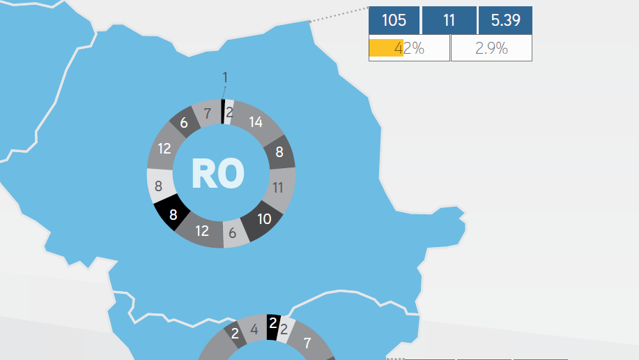
The number of Fortune Global 500 companies present in Central and Eastern Europe varies from approximately 60 in Slovakia and Bulgaria to 139 in Poland. Although Poland is the largest economy in the region, the ratio of companies in Fortune Global 500 present locally and population size is higher in Slovakia, Hungary and Czech Republic. This is linked to the high export to GDP ratio in these countries, namely 97% in Slovakia, 87% in Hungary and 79% in Czech Republic.
These are followed by Bulgaria (65%), while Romania and Poland have lower ratios (42% and 55%, respectively).
In terms of the most attractive sectors, Romania follows the trends in the region, with the highest presence in the automotive sector – 14 Fortune Global 500 companies active locally. This is followed closely by food, beverages and tobacco and by technology, with 12 companies each.
“The quantitative development of the real estate market follows due to economic growth driven by EU membership but the qualitative development is closely tied to the activity of the world’s largest and best performing companies. Regardless of what happens in the short and medium run considering concerns over the global economy, in the long run we can expect to see investor yields on office buildings and warehousing drop sensibly due to top tenants that will raise the bar in the local economy,” said Silviu Pop, Head of Research at Colliers.
The analysis of foreign direct investments in the past 15 years shows a high number of Fortune 500 companies in Automotive, Industrials, Food, beverages and tobacco, Telecom & media and Transportation present in the region. The tech sector is also very well represented.
On the other hand, large companies in Financials and Consumer goods and retail are not very well represented, and companies in Energy are relatively absent, most likely due to structural reasons.