
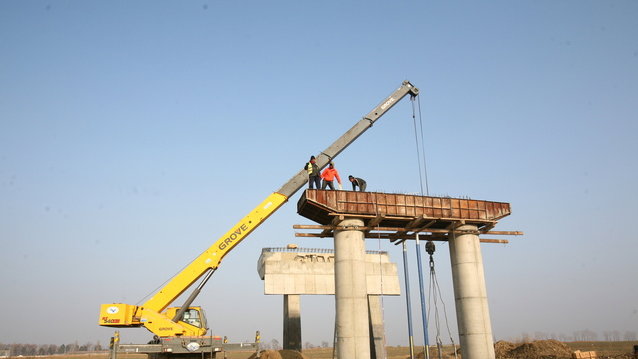
“Yes [we are interested in other concession projects of the Romanian state]. Actually we are very interested in any type of transportation infrastructure projects,” Tan Lu, a representative of the Chinese group, told Ziarul Financiar. If the company wins the concession project for the Comarnic-Brasov highway, CCCC will enter the European Union market, where most concession and public-private partnerships have largely favored western companies. The Chinese group has, however, won a contract in a non-EU country, Serbia, for the construction of a bridge.
“We have the financial strength to meet the project’s [Comarnic-Brasov] financing needs,” Tan Lu explains.
The Comarnic-Brasov highway is the only road in Romania that has already been through a process of finding a private investor interested in constructing, financing and operating it. But the two previous attempts of the Romanian state to find a private partner failed.
“Based on the preliminary understanding of this A3 Motorway Comarnic-Brasov project we recognize that all the elements of the project described in the owner’s documents are the strong specialty of CCCC,” says Tan Lu, explaining why the Chinese company decided to take part in the auction for the concession of the Comarnic-Brasov highway.
Road infrastructure projects conducted by CCCC include the 143 km-long Beijing-Tianjin-Tanggu highway and 274 km-long Shanghai-Nanjing highway in China.
CCCC had revenues of over EUR35 billion in 2011 and a profit of EUR1.4 billion, according to ZF calculations based on the financial results on the group’s website.
CCCC is one of the largest construction groups in China, specializing in roads and bridges. CCCC ranked 216th in last year’s Global Fortune 500 ranking, ahead of multinationals such as Google, Aegon, Iberdrola and Canon.
The Comarnic-Brasov highway for which CCC is bidding is set to be 58 km-long, have 18 tunnels and cost around 5.3 billion lei (EUR1.2 billion).
The bidders are CCCC and three joint ventures, namely of companies Spedition UMB and Tehnostrade, that of Vinci, Strabag and Aktor, as well as the one made up of Impregilo and Salini.
(English version by Daniela Stoican)