
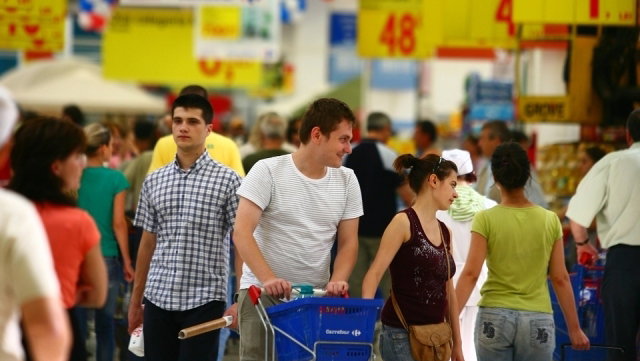

“The trend of consumption has been a pleasant surprise this year. It’s clear things have started going into the right direction and consumption growth is no longer just an official figure”.
Consumption rose by 9.3% in the first three months of this year against the same period of 2013, according to National Statistics Office data. According with the same source, the advance was supported by sales of both food and of non-food products and fuel.
In 2013, consumption edged up by 0.5%, with the advance being backed up by sales of non-food items.
“We cannot anticipate what will happen in the following months, but we hope the trend maintains. I can see people coming to stores for shopping, but I can also see other fields of the economy moving. Renovation works have started in real estate, and Bucharest’s old town is alive again,” says Jean Baptiste Dernoncourt, the French who runs Carrefour’s around 150 stores in Romania, with annual revenue of above EUR1 billion.
Despite waning consumption, food retailers have further invested billions of euros in expansion, opening between 150 and 280 stores per annum. Store openings were meant to keep retailers’ businesses in the black as sales per square meter, the most important indicator for consumption and for a company, dropped by 40-50% during the crisis.
French group Carrefour ended 2013 with net sales of EUR1.006 billion, up 2% from the previous year, according to the company’s financial report. Growth came as the company opened 54 stores.
However, the group’s officials did not report the trend of like for like sales that do not include expansion.
In 2009-2013, the company invested over EUR100 million in store openings, according with ZF estimates. The company brought several store formats on the market and plans to open stores under Supeco format.
“Supeco, though held by Carrefour, has a different management,” says Dernoncourt without providing further details.
As regards this year’s expansion, he only says two new hypermarkets will be opened.
“There is still room for hypermarkets in Bucharest and Romania. There is potential for new stores (of all formats) in Romania, both in rural and urban areas”.
However, Dernoncourt does not provide figures or details about supermarket and proximity store formats.
(English version by Catalina Apostoiu)