
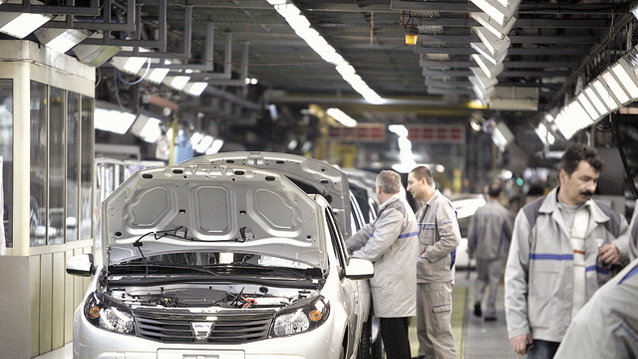

“High added-value exports outran textile and leather product exports in terms of weight during this period, particularly in the wake of foreign investments,” said Chirca during a conference hosted by the central bank to mark 134 years since the institution’s establishment entitled “Transformations of the Romanian economy”.
Chirca showed exports increased 4.4 times from 2000 to 2013, from EUR12 billion to almost EUR50 billion, but their weight in the gross domestic product advanced only from 27.8% to 34.8%. The biggest increase in this period was registered by agro-food product exports, from EUR368 million in 2000 to EUR5.2 billion in 2013.
This export increase was possible also amid Romania’s rising external indebtedness. The growth rate of external debt was double the one posted by exports during this period, from around EUR11 billion in 2000 to EUR96 billion in 2013.
During the conference, Dorina Antohi, a director at the central bank’s Monetary Policy Department, spoke about the trend of the interest rate during this period, noting that the key rate transmission toward banks’ lending interest rates has started functioning in the past seven years. However, she pointed out that the loan interest rate margin against Robor is higher than in Eastern Europe for companies and smaller for the population. Thus, lending to non-financial entities is twice as expensive as in the region.
Ella Kallai, a chief-economist at UniCredit, noted that the trend of the volume of retail lending, a downward one in the past five years, depends on the weight of employees’ remuneration in GDP, which dropped from 42% in GDP in 2008 to 33% in 2013.
In his turn, Lucian Croitoru, adviser to the central bank’s governor, said that the level of economic growth depends “a little” on lending resumption.
Antohi showed that only 13%-15% of Romanian companies borrow from banks, but Steven van Groningen, Raiffeisen Bank president, stated that out of the 400,000 enterprises operating in Romania only 200,000 generate profit and are therefore bankable and most of them are very weakly capitalized.
Elena Iorga, a director at the Economic Studies Department of the central bank, pointed out the concentration of industrial investment in the west of the country in the detriment of the southeastern and northeastern areas. She also said that, mainly due to the economic growth registered in the last 15 years, labor productivity in Romania came to 52% of the average of EU countries and 72% of the average of new EU member states.
On the other hand, academician Lucian Liviu Albu said Romania’s biggest issue is still the high weight of agriculture workforce.
Overall, changes were positive ones, concluded central bank first deputy governor Florin Georgescu, referring to the quite neuter title of the conference. “You can say ‘Generally good transformations in the Romanian economy’,” said Georgescu.
(English version by Catalina Apostoiu)