
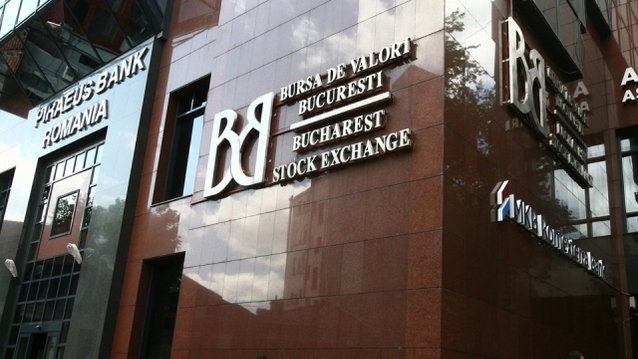
The Bourse expects two or three leu bond issues next year.
While politicians keep delaying the sale of stakes in state-owned companies on the stock market, and private companies are not willing to float to raise cash because they are not properly valued on the local market, raising cash via bonds on the stock market might take off next year.
Natural gas distribution company GDF Suez Energy was the first private company to release a bond issue worth 250 million lei (EUR55 million) on the local stock market in years. The bonds issued in October will be listed on Tuesday November 20.
“Two or three leu bond issues are being discussed for next year. As for floatations, I think we will see two or three of them for state-run companies, which were delayed,” said Victor Cionga, the general manager of the Bucharest Stock Exchange during the annual conference of the Romanian Association of Financial-Banking Analysts. “There are also talks for private companies but everybody is waiting for the beginning of the next year.”
Raising cash from the stock market via bonds can be an option for companies as banking lending has not exactly thawed up. Companies can therefore get cash from investment and pension funds, which have accumulated significant assets over the past few years and are constantly looking for new investments. Mutual funds’ assets now stand at RON8.6 billion, while pension funds’ assets reached RON9.6 billion.
“The investment funds are the success story of recent years. In 2008 we were at the bottom of the ranking along with Bulgaria. Assets have gone up eight times in the last four years and we’ve left Slovakia and Slovenia behind and are getting close to Hungary and Czech Republic and will probably be at the same level as they are in three or four years,” said Dragos Neacsu, chairman of Erste Asset Management.
“The supply wasn’t there, though. This is why we insisted that GDF bonds be listed here instead of the Luxembourg market where there are already one billion euro worth leu-denominated corporate bonds.”
He says that in order to stimulate listing of bond issues on the stock market the required paperwork and fees need to be changed. “It’s very important that we move past the current stage. It took us four months to put together the paperwork for GDF, while in Luxembourg it takes two weeks.”
Neacsu believes that other issuers who chose Luxembourg may open up to the Bucharest Stock Exchange if the issues are addressed. The European Bank for Reconstruction and Development might launch a new bond issue on the Bucharest Bourse to become a benchmark for the future issues.
More than 90% of the mutual funds’ assets are invested in low-risk securities: bank deposits, government paper and corporate bonds, while investments in stocks are really small, just tens of millions of lei.
The low liquidity of the stock market is becoming an increasingly bigger problem for pension funds. They have invested about 11% of their assets in shares so far, even though they may invest up to 30% in theory. The main reason is the low supply on the Bucharest Stock Exchange.
“The stock market has become much too small in volume compared with the growth rate of pension funds. Unless new issuers come up, liquidity will continue to decline and the funds will be stuck with non-liquid shares or will be forced to migrate to more liquid markets,” said Radu Craciun, deputy general manager of Eureko Pensii.
He added pension funds need both quality companies to invest in and predictability.
The chairman Bucharest Stock Exchange, Lucian Anghel, said the current problems of the market cannot be fixed overnight and it will take many years for the local market to match Poland’s or Turkey’s level.
(English version by Loredana Fratila-Cristescu)