
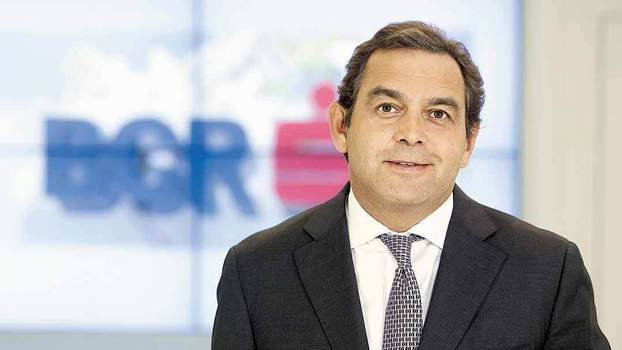
BCR has about one year to do it, Spurny says, adding, “Economy will resume growth if not at the end of this year then definitely in 2014, so we are under pressure to reach a position where to take advantage from the start of the growth cycle.”
The program that Spurny’s team started implementing with the help of US consultancy Bain means changing BCR’s business model and thoroughly reorganizing the bank, with a new corporate and retail approach and a strong non-performing loan management platform that should make as much money as possible from an up to EUR4 billion portfolio.
Sets of precise steps have to be implemented within 18 months by dedicated teams; coordinating and managing the whole process is a big challenge.
Spurny says his ambition is not to improve BCR’s financial performance as much as it is to build a sustainable bank that will not have any more problems in the future. He is fully committed to the project to transform BCR and says he is ready to remain in his position for as long as needed to attain the goals.
“This is an opportunity I have been expecting for a long time,” Spurny said adding the bank would be his masterpiece as a manager.
The year 2012 will remain a dark year in the history of BCR, due to the unprecedented loss of 1.2 billion lei (EUR275 million). This also includes the RON118 million costs of network and personnel restructuring, even though the actual steps continue to be implemented this year.
More than 100 branches have been closed but BCR’s boss says 15 or 20 new ones could be opened this year while 25 or 30 will be relocated.
The bank will also seek better locations for up to 700 cash dispensers, after having moved about 200 ATMs last year. The machines will not be upgraded any sooner than 2014 or 2015, because the priority is to improve proximity to stimulate usage.
The program to turn around BCR was built to be implemented over eighteen months, but the biggest decisions will be applied in the first twelve months, according to its CEO.
No business area and no organizational structure will go unreviewed.
The branch network will be fully evaluated so as to see where they are located, how they are used, managed and organized. A new philosophy will be implemented to serve the corporate customers, moving from a general approach to specialization on main industries and bankers who understand the specificity of various sectors in depth.
The retail business will no longer focus on the number of products, but on how simple they are, how easy the customer understands what they are and on their potential to generate robust sales. BCR will also introduce part-time positions in the second quarter so as to allow more flexibility in staffing for the daily and monthly peak times in dealing with customers.
The bank will continue to grant retail loans solely in lei, even though it has not sold as many loans in lei as to replace what it lost when it decided to stop offering euro loans.
Spurny also wants the bank to gain market share on the transaction and current account segment, including card usage.
An improvement in standardization of document processing and development of the transaction offer, with a focus on national and international payment services are being prepared for the corporate business segment.
Under the circumstances, BCR decided to create a transaction banking unit, for which it recruited experts from competitors; the new unit will report to vice-president Sergiu Manea. The transaction banking executive director position was given to Slovak executive Lubor Prochazka, who came from Raiffeisen-owned Tatra Banka.
The new corporate business model is to be discussed with the labor unions and should be implemented at the end of the month.
BCR has to carry a burden of EUR3.5 billion to EUR4 billion in non-performing loans and one of the major goals of its turnaround program is to create as powerful an entity as possible to make as much money as it can from these assets.
The new unit managing non-performing loans, named “opportunity bank” internally has been approved at the end of 2012 and is currently employing 350 people. Personnel should increase to 500 people by the third quarter.
The manager of the unit will be Dutch executive Jurgen de Ruijter, trained at ABN Amro. He has been working in Romania since 2008 and reports to executive vice-president risk, Michael Beitz. The debt collection company Suport Colect established in 2009 will be integrated into the new unit.
Tomas Spurny also sees the computer infrastructure as important and says it deserves the biggest investments and support, because it is crucial for a bank. (EUR1=RON4.3612)
(English version by Loredana Fratila-Cristescu)