
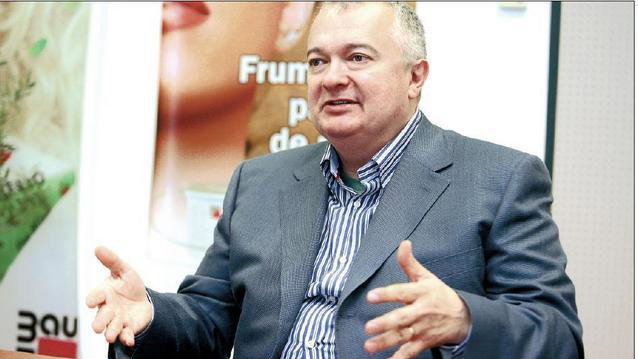
“2012 has been extremely difficult, the most difficult in the 17 years I have worked for Baumit. (…) This was a year when Baumit faced difficulties and there was a clash between the wish of suppliers of raw materials to increase prices on the one hand and on the other hand the express and obstinate wish of [distribution] partners for Baumit to cut product prices. This is impossible if we want to keep the company’s financial health,” says Lupusor, who runs Baumit Romania, part of Austrian group Schmid Industrie Holding.
Despite market difficulties, Baumit, which entered the Romanian market in 1995, estimates that its turnover will see a slight rise this year, by around 3% against last year, when the company had a turnover of EUR29.3 million. How does Baumit’s manager explain this year’s turnover increase? “We have a very wide range of products, hence our chance of finding a loophole. Diversity helps, if some products fare worse, others sell better,” Lupusor says.
Around 75% of the company’s turnover is generated by sales made to distribution companies and to the major DIY chains, while 25% is accounted for by direct sales to construction firms and by exports.
The Baumit manager has this year noticed an increase in the share of DIY chains to overall sales, a trend that appears to be specific to the entire market.
Plans for a new plant put off for now
Baumit Romania has two dry mortars plants, in Teius, Alba county and in Bolintin, Giurgiu county, with a cumulated production capacity of over 600,000 tons per year. The company also owns a wet products plant (dyes and mortars) in Bucharest, which produces over 12,000 tons per year. Laurentiu Lupusor said last year in an interview to Ziarul Financiar that Baumit could consider building a new dry mortars plant in Romania, after the latest Romanian plant of the Austrian group was opened during the crisis, in 2010.
“Projects of this type are postponed. Today these projects are rethought and repositioned on the European map so that Baumit can have the opportunity to deliver products regionally. One tries to streamline such investments to the maximum extent possible,” Lupusor says.
The dry mortars market, where Baumit operates, stagnated this year and for 2013 the company’s manager expects a stagnation, as well.
An exchange rate of RON4.6 to the euro
Baumit Romania has around 160 employees at present, with exports to countries such as the Republic of Moldova, Bulgaria and Kuwait accounting for around 5-6% of the company’s turnover.
The company’s manager has built next year’s budget based on an exchange rate of around RON4.6 to the euro.
“The estimate has been made by us based on banks’ forecasts, on those of other business people and on our own evaluations. The exchange rate has become a lottery, but for those who understand the mechanisms behind it, it is very important,” Lupusor explains. He also says Baumit has set more optimistic targets for next year, expecting a turnover increase of up to 10%.
“We will seek to approach our target, despite the fact that a new wave of turmoil awaits us in 2013.”
(English version by Daniela Stoican)