
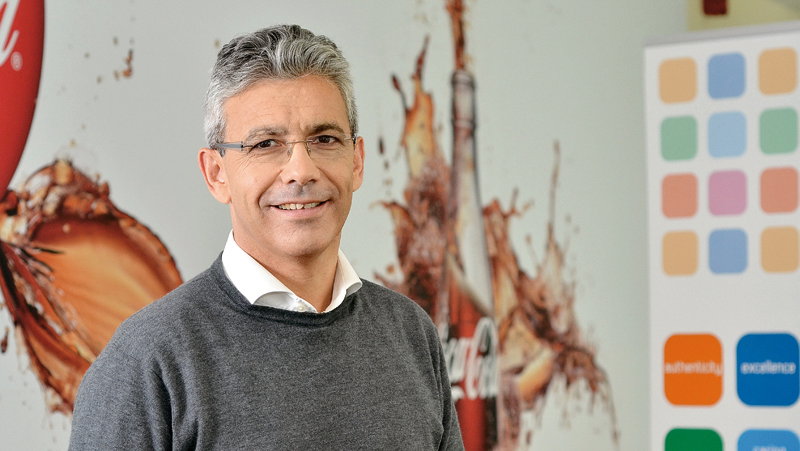
“I don’t see major changes in 2014. I’d bet on 2015 and I think this is the year when Romania’s GDP will continue to grow, and consumer confidence will return, purchasing power will increase, bringing consumers back not only to the soft drinks market but to the entire market,” Batoux told Ziarul Financiar in an interview.
Batoux, who has been in Romania for five years, says most companies reset their business and adjusted their organizations to the new market conditions in 2012 and 2013 and will now restart investments.
The 48-year old French executive who had previously run Danone Romania, says Coca-Cola could consider building a new plant in Romania only if the soft drinks market sees sustainable growth at a mid to high single digit rate in the next two or three years. Coca-Cola now owns three production facilities in Romania, in Timisoara, Vatra-Dornei and Ploiesti.
How can Romanian consumers regain confidence?
First of all they need stability, both political and monetary. They want to see inflation under control, the domestic currency stable and the government taking care of the country’s funds and not allowing the deficit to grow, Batoux says.
Looking at the current economy, one can see Romania has it all, it is the country with the highest growth of the gross domestic product in the European Union (in the first nine months i.e.), he added.
While he talks freely about the market conditions, consumer spending and consumers, Batoux is not so forthcoming when it comes to details about the company he runs, so the only figures about Coca-Cola’s sales performance available are those in the quarterly reports of the parent company in Greece.
The sales volumes shrank 15% in the first nine months, which the company blamed on the unfavorable macroeconomic conditions and competitors’ promotions pressure.
Coca-Cola HBC Romania could end the year with lower sales volumes, after having posted growth of only 1% in 2012. Last year however, it posted a 6% increase in the sales in euros after five years of decline, reaching EUR435 million, while profit rose to EUR33 million.
Coca-Cola closed three plants in Romania after 2005. It makes 90% to 95% of the Coca-Cola drinks sold in this country locally, while imports come from Greece, Bulgaria, Hungary and Poland, where it also has plants. It imports the 250 ml Burn energy drink and the Illy coffee.
“We export 5% to 10% of the production in Romania. The exported products are Dorna, Cappy Pulpy, Nestea and Burn in 500 ml containers, Fanta, Schweppes, Coca-Cola (…) and we export them to Austria, Bosnia, Bulgaria, Croatia, Cyprus, Czech Republic, Greece, Hungary, Moldova, Poland, Slovakia and Slovenia.
The soft drinks market fell at a single-digit rate in the first nine months, according to market research company Nielsen data, which Batoux cited.
Coca-Cola has some 1,800 employees in Romania and Batoux says the company is constantly hiring and has added 190 new people to its team since the beginning of 2013.
The company exports managers of all levels and two people of his team left abroad to Italy and Bulgaria. Manager export also means it also recruits people, Batoux said.
This year Coca-Cola recruited ten young graduates to become the next generation of managers. One of the managers ‘exported’ is Lucian Marin, appointed commercial director at Coca-Cola Hellenic Italy last fall, after having held the same position with Coca-Cola HBC Romania and Moldova.
Early this year, Simona Simion-Popescu, Coca-Cola Hellenic Romania and Moldova’s country human resources manager moved to Bulgaria as director of Coca-Cola Business Services Organization Bulgaria.
What advice does Stephane Batoux have for the youth who want to pursue an international career?
The first thing to do is to secure a scholarship and Batoux himself was one of the first to get an Erasmus scholarship in 1984, going to UK and that was how he “felt the taste of international assignment”.
(English version by Loredana Fratila-Cristescu)