
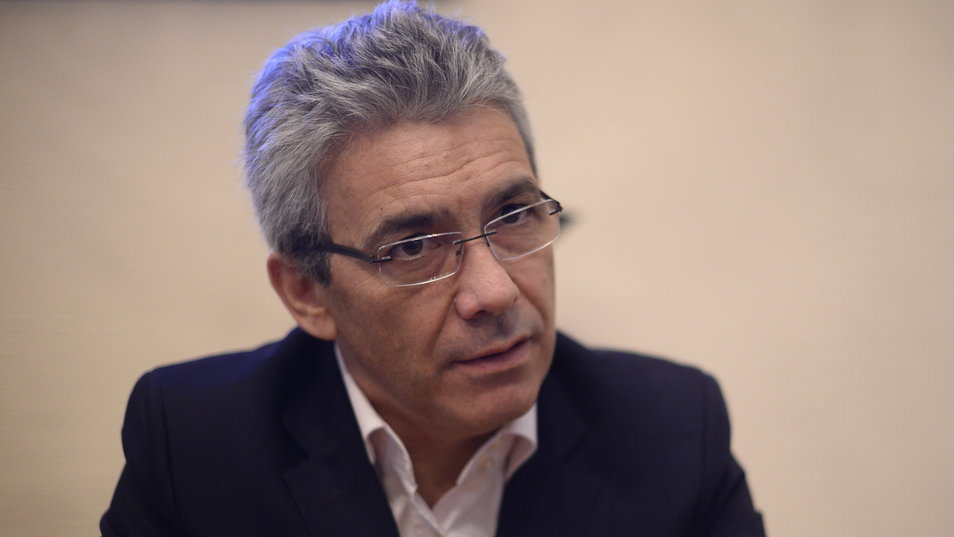
”We are thinking of exporting. We are seriously looking at what and where we can export. We are the biggest Romanian-held dairy company and there is no reason why we should not export,” Stephane Batoux, 50, told ZF in an interview.
“Romania is a good export platform, there are many countries in the region with a higher dairy product consumption. Demand for our products is already there.”
Before joining Albalact, Batoux had run Danone Romania and Coca-Cola HBC Romania, two companies that export ‘made in Romania’ products.
Stephane Batoux replaced Albalact founder and shareholder Raul Ciurtin as chief executive in mid last year. Ciurtin kept the position of chairman after having taking the business from EUR16 million to almost EUR100 million sales in the past ten years.
Batoux’s statement shows a U-turn in Albalact’s development plan considering Raul Ciurtin told ZF in May 2014 that he was not interested in exports.
“We are trying to see where we can grow and there are such segments, but we are not interested in exports. The chance of a Romanian producer to enter international markets is to work as a private label producer for a retailer and I am not willing to go to Hungary or Germany, for instance, to make deliveries to a store chain. Getting your own brand on shelves abroad is costly,” Ciurtin said less than a year ago.
The new CEO, however, seems to have persuaded him that development can come from foreign markets. Export is something multinationals are much better at than Romanian entrepreneurial businesses.
Batoux says the main reason why Ciurtin asked him to join his company was that he wanted him to implement certain processes, to make the company stronger so as to enable Albalact to continue to do well over the coming years.
In 2013, Albalact, which is listed on the Bucharest Stock Exchange, became the second largest company in the local dairy industry after Danone Romania. It posted 423 million lei (EUR94 million) revenue in 2013 and set out to overshoot the EUR100 million mark in 2014. Batoux did not comment on the 2014 results.
“I think Albalact had already been planning to become number one of the dairy market before I came.”
Batoux sees Albalact taking the lead on the dairy market in three years. Albalact is now number one on the butter, milk and cream segments.
The French executive says he joined Albalact not after having been sought by a headhunter – the traditional way to recruit a chief executive, but after receiving a call from Raul Ciurtin himself, whom he had met while he was running Coca-Cola HBC Romania. When they first met they discussed a few things about Albalact with Batoux providing some input, after which they met a few times by chance.
When Ciurtin heard Batoux was leaving Coca-Cola, he called him to ask whether he would like to come work for Albalact and this is how he took the reins of the local dairy company. The French executive says this is the first time he has worked for an entrepreneurial company so he will have a lot to learn in this position but he will also be able to help the business with his expertise.
The first major difference between a multinational and an entrepreneurial company resides in how strategy is applied, Stephane Batoux says.
He is one of the few expats in Romania running an entrepreneurial business. Strategies in a multinational are sent from the headquarters, while in a Romanian company they are made locally.
The second big difference has to do with the investment strategy, because investments of multinational are made with international opportunities in mind, so it may choose to direct more investments to one part of the world, while investing less in others.
In Albalact’s case, investment goes towards only one business.
Moreover, while in a multinational one spends about three years on a job and may then leave to another country of the same company, a Romanian company feels more like a family, Batoux says. (EUR1=RON4.4935)
(English version by Loredana Fratila-Cristescu)