


Approved by shareholders on November 15, 2011, the merger of Greek groups Alpha Bank and EFG Eurobank (the majority shareholder of Bancpost) has yet to take place, with legal procedures now dragging on because of the competition authorities.
Uncertainty therefore lingers for local subsidiaries, leaving room for speculation: who will run the future Alpha-Bancpost bank which is set to rank third by assets, how the other managing positions will be divided up, how many people will be fired, how the balance sheets of the two banks will be consolidated, to what extent the new bank will be able to support financing for clients, especially big ones.
Although the merger was announced in August last year, Bancpost and Alpha Bank continue to pursue individual targets and keep silent on prospects of unification, awaiting decisions in Athens and leaving it for the parent banks to communicate on the subject.
But the major objectives of the two banks coincide because of their similar situation: at the end of September 2011 both Alpha Bank and Bancpost were in the top ten banks in terms of losses recorded according to Romanian accounting standards. Alpha posted a loss of nearly 120 million lei (EUR27.7 million), while Bancpost recorded a loss of RON75.3 million.
Therefore, the priority for both banks is to cut costs in order to return to profit, with Bancpost having less ground to cover to breakeven.
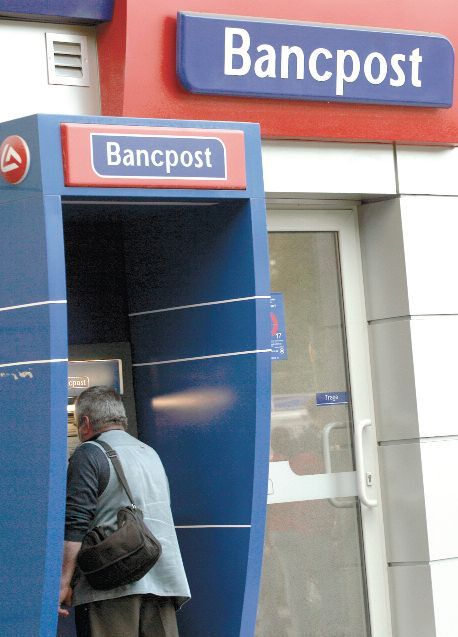 Market sources say Bancpost even accelerated restructuring measures in the fourth quarter, both by cutting personnel and by relocating employees from one area to another. The bank has also made efforts to cut rent costs for its subsidiaries.
Alpha Bank is also seeking to cut costs, mainly looking at the situation of the branch network outside Bucharest. Bancpost’s network is around 100-unit larger than Alpha Bank’s and their offices are rarely close to one another.
Another common objective is to secure liquidity from clients. In addition to paying some of the highest interests on the market, Alpha and Bancpost have to spend periodically on advertising campaigns aimed at persuading clients to renew their deposits.
Market sources say Alpha Bank was more affected than Bancpost as far as deposit withdrawals are concerned.
After the first nine months, data published in Athens show that the volume of Alpha Bank deposits fell by around 17% against the previous year.
Both banks are making efforts to persuade their clients not to withdraw their deposits, offering them better terms, but the price for this is the vicious circle of high costs that undermine profitability.
As far as lending is concerned, Alpha Bank is fighting to consolidate its place as no. 3 in the First home scheme after BCR and BRD, this remaining the bank’s main product on the retail segment, entailing a minimal risk. Bancpost is not eager to promote its retail loans, instead focusing on shopping cards.
According to market sources, a delicate segment for both banks is financing to major clients, with both banks making efforts to get out of certain transactions and encouraging refinancing from other banks that can still afford to take exposure.
Reducing balance sheets is a standard solution to reduce financing and capital needs. Both banks increased their capital in 2011 as demanded by the central bank, but it remains to be seen whether they will need further funds by the time the merger is completed on the local market.
As for the management of the future Alpha-Bancpost bank, the situation has not been decided yet, with several scenarios flown around in the banking environment.
One of them is for Sergiu Oprescu, the current executive president of Alpha Bank to go on to run the new bank, as well.
And this at a time when Peter Weiss, who has been at the helm of Bancpost for just over a year, is reportedly not as determined to fight for the new job.
But there is also the variant of Athens sending a Greek banker to helm the local bank, considering the size and share of the new bank in the operations of the Alpha Eurobank group resulting from the merger. (EUR1=RON4.3347)
(English version by Daniela Stoican)