
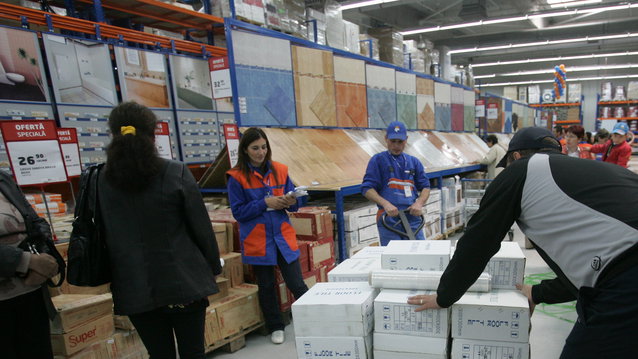
With such an expansion rate it looks like the market reverted to 2004, when six stores were opened. In the peak year 2008 the companies on the market completed one store every 20 days for a total of 18, according to a ZF analysis.
The market has reached a certain saturation at least in the large cities, given that the number of these DIY ‘hypermarkets’ went from zero in 2002 to more than 100 at the moment.
Romanian-owned Dedeman was the most active chain this year; it opened four stores in which it invested EUR47 million. With the new openings in Constanta (EUR15 million investment, its second in the SE Romania city), Ramnicu-Valcea, Slatina (southern Romania, EUR12 million and EUR10 million investment), and Bistrita (north of the country, EUR10 million), Dedeman’s network grew to 30 stores, the largest on the local market. Sales could exceed half a billion euros this year.
“Chances of us opening another store this year are slim,” said Dragos Paval, chairman and majority shareholder of Dedeman, adding that the company was working on the details of next year’s store openings.
Dedeman made the most of the crisis and the low land price and labor costs, and opened 18 large stores in 2009-2012, in which it invested more than EUR200 million and became the market leader. Its target is to drive the network to 45 stores by 2015.
The other networks that opened stores this year are Hornbach and BauMax, which chose to expand to two of the country’s largest cities Timisoara and Cluj (W and NW of Romania).
Hornbach, whose sales in Romania reached EUR85 million last year, now has five stores, after completing its latest investment (EUR30 million) in Timisoara, while BauMax spent EUR20 million on its second store in Cluj and its 15th in this country.
Praktiker and Bricostore, which used to call the shots on the market in 2002-2008, reached expansion peak in 2008 when each of them opened five stores and have not completed any such investment this year.
On the other hand, Leroy Merlin, which entered the local market by opening a store in Chitila (NW Bucharest) a year ago, has had a rather cautious expansion policy so far.
Other competitors on the DIY market are OBI and Mr. Bricolage, a network controlled by the Rapotan family of Galati (SE Romania), who also owns construction supplies distributor Arabesque. These companies, however, did not saw 2012 as a good year to invest.
The year 2013 is also expected to be a year with few investments in this field given the still sluggish construction market.
(English version by Loredana Fratila-Cristescu)