
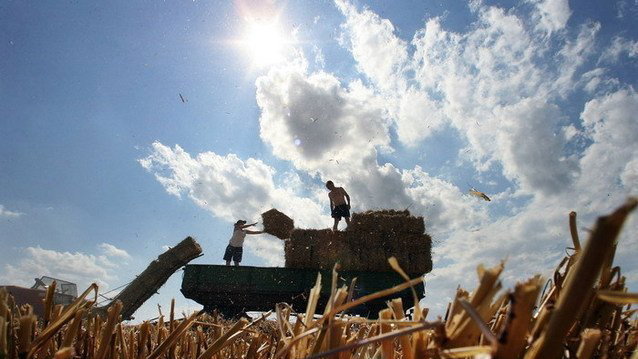
Production decline in agriculture was the result of a droughty year with very poor grain and oilseed (sunflower and rapeseed) harvest. However, the decline was kept in check by the fast-paced increase in the price of the main agricultural products.
Moreover, the 2012 production was within the average of the last six years, therefore the EUR3 billion decline was not enough to change economic growth calculations.
“2012 was not as a bad an agricultural year as it was initially made out to be, but last year’s drought will have an impact this year, because work on the land was delayed and the rapeseed has grown much too fast in the last few months and farmers had to do something to slow it down,” explains Gabriel Popescu, PhD, a professor with the Faculty of Agrifood and Environment Economics of Bucharest University of Economic Studies (ASE). “Agriculture will remain a growth driver for the economy, the sector remains strong and a beast of traction for the economy.”
The worse results in agriculture last year were caused by the droughty year that severely affected the crops of the farmers who planted wheat, corn, sunflower and rapeseed.
Eurostat statistics show that last year’s agricultural production is within the average of the last six years and the decline of 2012 is the result of a high base effect. As the GDP did not increase that much last year, the contribution of the agriculture to the economy should be the same as in 2011.
“We cannot blame the nature. There was the drought, of course, but the results in the economy are good and the industrial agriculture – the medium-sized and large farms, were not affected that much and therefore there are no problems in the processing chain,” Popescu added.
Gabriel Popescu says agricultural production will generate EUR18 billion to EUR19 billion every year as it did in 2011 only when farmers direct substantial funds to state-of-the-art irrigation systems.
“The average agricultural production will go up to EUR18 billion to EUR19 billion only with real state-of-the-art irrigation systems, unlike those energy intensive systems in place in 1989.”
The lack of a developed irrigation system leaves local farms almost completely vulnerable to the vagaries of weather. Total exposure to drought therefore makes grain, oilseeds or fodder harvest highly volatile, crops that contribute EUR4 billion to EUR5 billion to the overall economy every year.
Five of the seven most important crops did worse than in 2011. The only crops that did better were wine and vegetables, which increased by 13.5% and 23.8%.
Professor Dumitru Miron, PhD, with the Department of International Business and Economics of Bucharest University of Economic Studies, says the EUR3 billion the agriculture lost last year cannot upset economic growth calculations.
He says that the EUR3 billion lost will be felt by the small rural households that are totally dependent on crops, though.
“Part of the agriculture is not included in any statistics, it is a gray area of subsistence farming and the impact is there because those households depend on what they produce and moreover, other households in urban areas depend on those in rural areas.”
The grain, industrial crops and fodder farmers were the most affected last year.
Whereas such crops contributed EUR7.7 billion to the economy in 2011, their contribution was down by two thirds at the end of 2012.
The grain market lost about EUR2 billion in revenue, in addition to EUR383 million and EUR447 million from industrial crops and fodder.
The decline of these crops was partly offset by the rise in their prices. Eurostat data show that prices for such product categories rose by 4.6% to 19.3% in 2012. Volume decline stood at 28% to 45%.
Besides grain, industrial crops or fodder, potato production went down, too. Potato farmers lost EUR700 million in revenue after the production decreased by more than two thirds due to the weather.
“The production decline was due to the extended drought in 2012 in the potato-growing areas like Brasov, Covasna and Harghita (central Romania). By potato harvest time, it had not rained since June and average temperatures were very high (…),” explained Ioan Benea, chairman of the largest organization representing potato farmers in Romania, FNCR.
The decline in the value of the potato production was also because, as Eurostat statistics show, the average potato price went down 22.5% last year. This is not a typical situation because normally when the volume of production goes down, price goes up.
“Prices should normally go up for us to be able to offset costs as a result of production decline. It did not happen because we could not raise prices due to the lower priced imports from Poland,” Benea added.
He added the poor results of last year would make an impact on this year’s production and prices because farmers will have to deal with higher costs as a result of the low supply of seed potatoes.
Last year’s drought also hurt fruit farmers, with the fruit production going down 20% to EUR964 million.
“Productivity was down because of drought. Whereas our apple orchard yielded 50 tons per hectare in 2011, last year it only yielded 40 tons/hectare. The problem was that it did not rain in June, July and August and the fruits did not develop right when they needed water most,” says Gheorghe Florea, a representative of Asociatia Pomicola Itesti, which operates a 90-hectare orchard.
The 22% decline in fruit production was partly offset by the increase n prices, which rose by 8% on the average compared with last year.
The surprise of last year came from livestock farming, because production value on this segment was driven up by the rise in livestock prices. In all, production on this segment reached 4.3 billion euros, up 13% on 2011.
“There was a slight increase in prices of beef cattle, but the prices plummeted towards the end of the year as a result of the drought that drove fodder prices up making farmers queue in front of slaughterhouses to have their cattle slaughtered,” says Claudiu Franc, the chairman of the National Federation of Cattle Farmers in Romania, one of the largest of its kind in Romania.
He added the effects of the drought would show in both cattle prices and number of cattle head this year. “The number of cattle has gone down by 25% this year, we will see it reach 1.6 million to 1.7 million head.”
The cattle market has been dwindling for more than five years, losing about 1 million head in the meantime.
(English version by Loredana Fratila-Cristescu)