
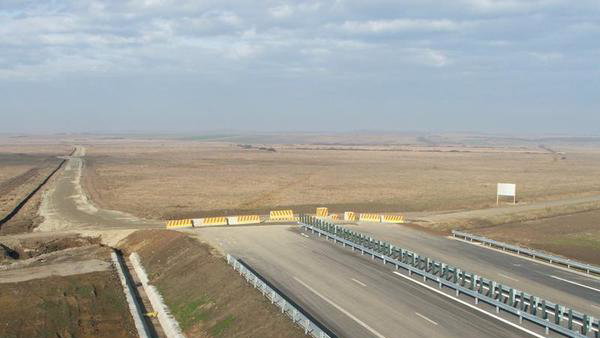

The General Transport Master Plan, a document that presents Romania’s priorities related to transport infrastructure until 2030 and that should be, at least theoretically, observed by all the future governments, was in the limelight in the field. For the time being, though, the document has not been approved.
Master Plan: Express roads in the detriment of highways
2014 brought a first draft of the General Transport Master Plan, the document that proposes Romania’s priorities in the field of transport infrastructure by 2030. The document has not been approved, yet, and since early autumn, when it was presented for the first time, it has undergone a series of changes as it had not included major infrastructure projects in the first phase.
An important aspect of the Master Plan is that it brings under discussion the construction of express roads in the detriment of highways and it also proposes the uprooting of 40% of Romania’s railways.
A “poor” year in terms of highway opening
In 2014, only 22 km of highways were opened to traffic, on the Cunta-Saliste route (the third section of Orastie-Sibiu highway), with the total length of the local highway network reaching 667 km. However, only several days after the highway was delivered the first problems emerged, because of some cracks.
The first section of Nadlac-Arad highway, between Nadlac and Pecica, is also likely to be opened to traffic by yearend. No precise deadline has been announced for the opening of this section.
New trains for Bucharest’s subway
The 16 trains acquired by Metrorex for almost EUR100 million from Spain’s CAF started being operated this year, beside the Swedish trains Bombardier and the older IVA ones, manufactured in Arad. Metrorex is set to acquire another 8 trains from CAF for which it will pay EUR47 million and is currently carrying out another auction to purchase 51 trains for some EUR440 million.
Uncertainty still hovers over Comarnic-Brasov highway
Comarnic-Brasov highway (53 km), the concession experiment the state has been struggling to complete for over one decade, seems to be on the verge of failure again, considering the concession procedure has made no headway in recent months. One year after the designation of the private investors that will build it, French Vinci, Greek Aktor and Austrian Strabag, no concession contract has been signed, yet, and funding sources are not clear, either.
Massive layoffs at CFR Marfa: 2,500 employees
State-run railway freight carrier CFR Marfa announced it would lay off 2,500 employees this year, after the government pledged to the IMF to aggressively reshuffle the company and take privatization further with a strategic investors, considering that the ceding of 51% in stock failed last year. By early November, CFR Marfa had already made 2,300 employees redundant, getting to almost 6,600 employees.
Dealul Negru, blocked for two month for trucks
For almost two months, traffic was restricted for trucks on DN7 between Pitesti and Ramnicu Valcea (on Dealul Negru), as a road section of several tens of meters was affected by a landslide. From this reason, trucks had to take a turn of around 100 km and spend around EUR50 more on fuel. Many road transporters were hurt, in the context where the road section affected by the landslide was no longer than 20-30 meters.
Bucharest’s Mihai Bravu passageway, opened to traffic
Traffic on the two bridges of Bucharest’s Mihai Bravu passageway was opened this year, in the wake of a construction contract worth 156 million lei (EUR35 million) completed by Italy’s Istaldi. The project had been initially gained by Romstrade, but the contract was annulled in December 2012, shortly after the building company went insolvent. Bucharest municipality had already paid RON37 million to Romstrade.
EUR450m worth of contracts for Sebes-Turda highway
This year, the local roads authority CNADNR signed four contracts totally worth some EUR450 million for the construction of the around 70 km between Sebes and Turda. This is the most important highway project CNADNR launched this year, being built with EU funds.
New runway at Iasi Airport
The new runway of Iasi Airport, which cost RON139 million (EUR32 million), was launched in August, one year after the start of works. The project is part of the airport’s development and revamping program, which also includes aircraft parking expansion and the construction of a new passenger terminal.
Low EU fund absorption for POS-T
Though Romania has just one year left to draw the money the European Commission is offering for the POS-T program related to 2007-2013 financial period, EU fund absorption for this program amounts to just EUR1.6 billion for the time being, the equivalent of 36.5% of the total EUR4.4 billion amount (according to end-October data). The absorption rate has been rising since the start of the year, when it stood below 20%, but it remains to be seen whether Romania will be able to draw the rest of the money in one year, by late 2015. Otherwise, it risks losing it.
(English version by Catalina Apostoiu)